
ChatGPT and Google's AI answers recommend the company that has the answer written on its own site and confirmed by third parties, in reviews, directories and lists. You can't pay your way into the answer, and an llms.txt file on its own changes nothing. On our site, appearances in Google's AI answers went from 262 to 1,482 in eight weeks and a manufacturer 900 km away reached us through ChatGPT, but contact through the site did not grow at the same pace.
How AI decides whom to recommend#
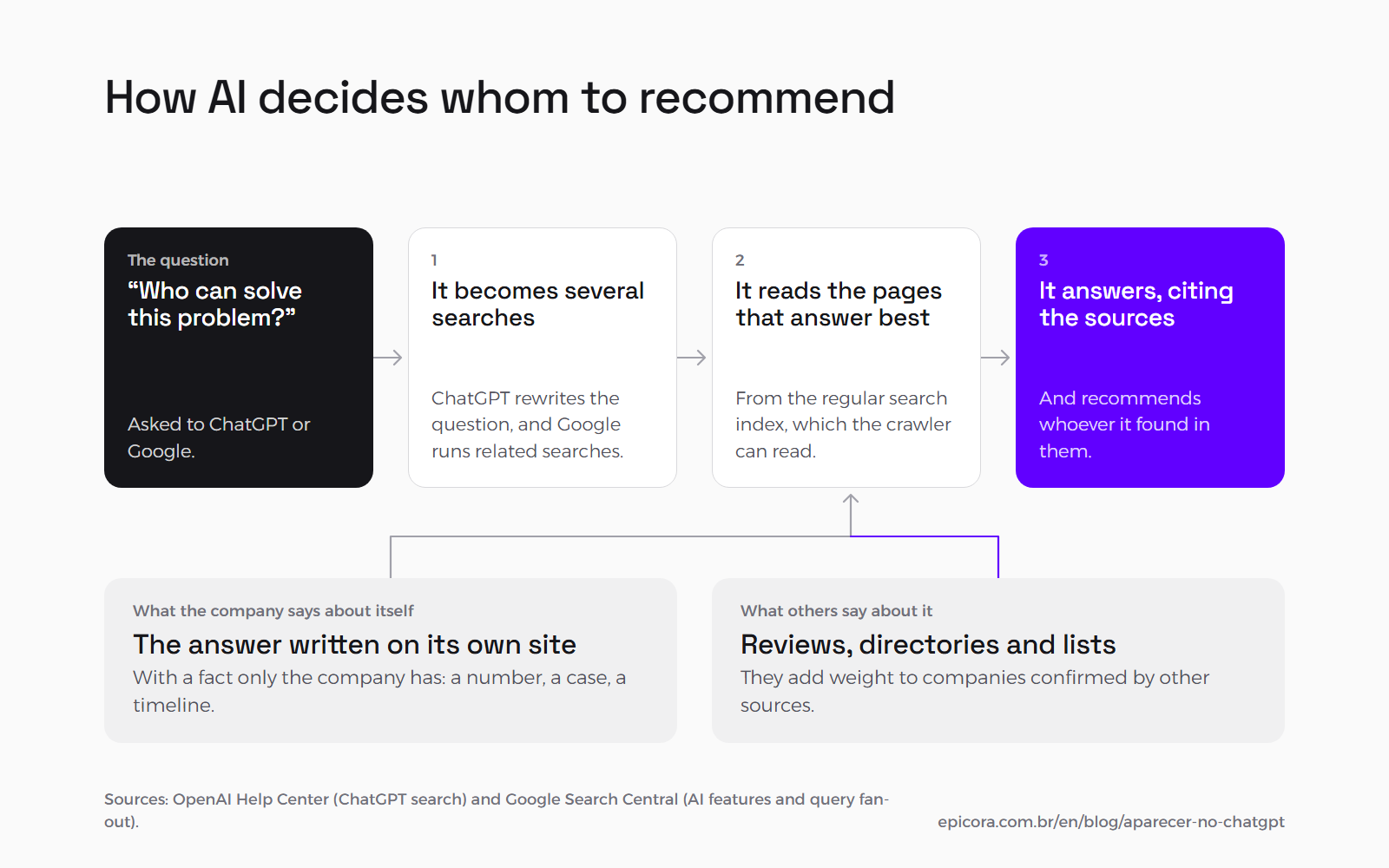
When someone asks ChatGPT or Google who can solve a problem, the AI runs web searches, reads the pages that answer best and builds a response that cites those sources. It recommends whoever has the answer written somewhere it can read, and gives more weight to companies that other sources confirm, such as reviews, directories and lists.
In early September 2026, a manufacturer in the interior of São Paulo state, about 900 km (560 miles) from our office in Chapecó, in southern Brazil, got in touch. The person leading the project had asked ChatGPT for an off-the-shelf system to meet a new requirement in the company's market. Because the requirement was recent, the AI had no ready-made system to suggest, so it recommended a company that could build the system to order: Epicora. Nobody referred us, no ad was running and none of our salespeople had spoken to the company before.
Until August, AI recommended us when the question was about Chapecó, and the contacts who said they came from ChatGPT were from the region. This was the first from far away, and it shows the whole mechanism: with no product to suggest, the AI went looking for someone who could build the system, and Epicora was among the companies it found.
OpenAI and Google describe the process in similar terms. According to the OpenAI Help Center, ChatGPT rewrites the question into one or more searches and can refine the search after reading the first results. According to Google Search Central, Google's AI answers, AI Overviews (the AI summary at the top of the results) and AI Mode, retrieve pages from the regular search index, with the same ranking systems, and run several related searches at once, a technique Google calls query fan-out.
In practice, the page has to be indexed and readable by the crawler, as in any search, and what other sites say about the company counts alongside what the company says about itself.
What a site needs in order to be cited#
To be cited, a site has to let the AI search crawler in, deliver the text ready in the HTML and have a page that answers the buyer's question at the start of each section, with a fact only the company has, such as a number, a case or a timeline. Google says there is no special format for AI and that original, clear content is what weighs most.
Google's official guide to generative AI features, updated in July 2026, says that content with an original point of view, from someone who has lived the subject, will likely matter more in the long run than any other suggestion in the guide. The table shows what we did on our site, which is built as code and runs in three languages, and the reason for each item.
| What to do | Why | What we did on our site |
|---|---|---|
Allow ChatGPT's search crawler, OAI-SearchBot, in robots.txt, and don't block Google's | according to OpenAI, sites that block OAI-SearchBot are not shown in ChatGPT search answers | 12 AI agents allowed by name, including OAI-SearchBot and GPTBot |
| Deliver the text in the HTML the server sends | in a December 2024 study, Vercel and MERJ found that the AI crawlers from OpenAI, Anthropic and Perplexity did not run JavaScript | each page's text already comes in the HTML; we checked it using OpenAI's crawler identification |
| One page per buyer question, with the answer in the first lines of each section | the AI cites a passage, and whoever arrives through it has not read the rest of the page | a 40 to 70 word answer under each heading, and each section with a fixed address |
| A fact only the company has: number of projects, timelines, a case with results | Google asks for first-hand content; ChatGPT quoted the phrase "more than 60 projects delivered" from our site | case studies with numbers; the Sistema Forja one is among the most cited pages |
| Dedicated About and Contact pages, with the company registration number, address and phone matching the directory listings | the AI cross-checks the site against listings to confirm it is the same company | About and Contact became their own pages in September; structured data with the registration number and company profiles |
| The site in other languages when there are readers abroad | the question may arrive in Spanish or English | the Spanish article about apps without signal is the most cited page on the site, with 160 appearances over 28 days in the October 23 measurement |
| A truthful last-updated date in the sitemap, the file that lists the site's pages | according to Google, the date is only used when it is consistently accurate | the real date of each page in the sitemap and an IndexNow ping on every publication, which reaches Bing and other engines (Google does not take part) |
Without the first two rows, the AI cannot read the site. The others decide whether, among the pages the AI read, yours is the one with the sentence it wants to cite.
The weight of first-hand facts shows in the pages the AI chooses. In the October 23 measurement, the Spanish version of our article on what changes in a system when the app has to work without signal was the most cited page on the site, with 160 appearances in Google's AI answers over 28 days. It was already in the lead on October 5, with 101, against 68 for the home page; in that measurement, the Sistema Forja case study had 34 appearances and the About page, 19, and six of the ten most cited pages were articles, case studies or solution pages.
If you have already organized your company's knowledge so AI can work with it, much of this material is ready. The platform choice that makes all of this possible is covered in what decides the platform for a company website.
Why reviews and directories weigh more than your own site#
Most of what AI cites was written by someone else. In our measurements, when the question is "which are the best companies" or "which ones exist in my city", the answer comes from lists, directories and rated listings, and the company's site only gets in if the company is in those sources. There, the business listing and directory entries decide whether the company appears.
According to Muck Rack's What Is AI Reading? study, updated in May 2026 with more than 25 million links cited by ChatGPT, Claude and Gemini across 17 industries, 84% of citations come from earned media, which is the editorial coverage others publish on their own, such as news stories and articles. Paid and advertorial content accounts for 0.3%. The weight of reviews and directories comes from our own test questions, not from the study.
In our test questions to ChatGPT, this shows up in the sources the answer cites. For the question about the best software houses in Brazil to build a custom system, the October 5 answer cited a rankings website and three software houses from other states, and Epicora does not appear. In September, one of the sources for the same answer was a directory where we are not listed.
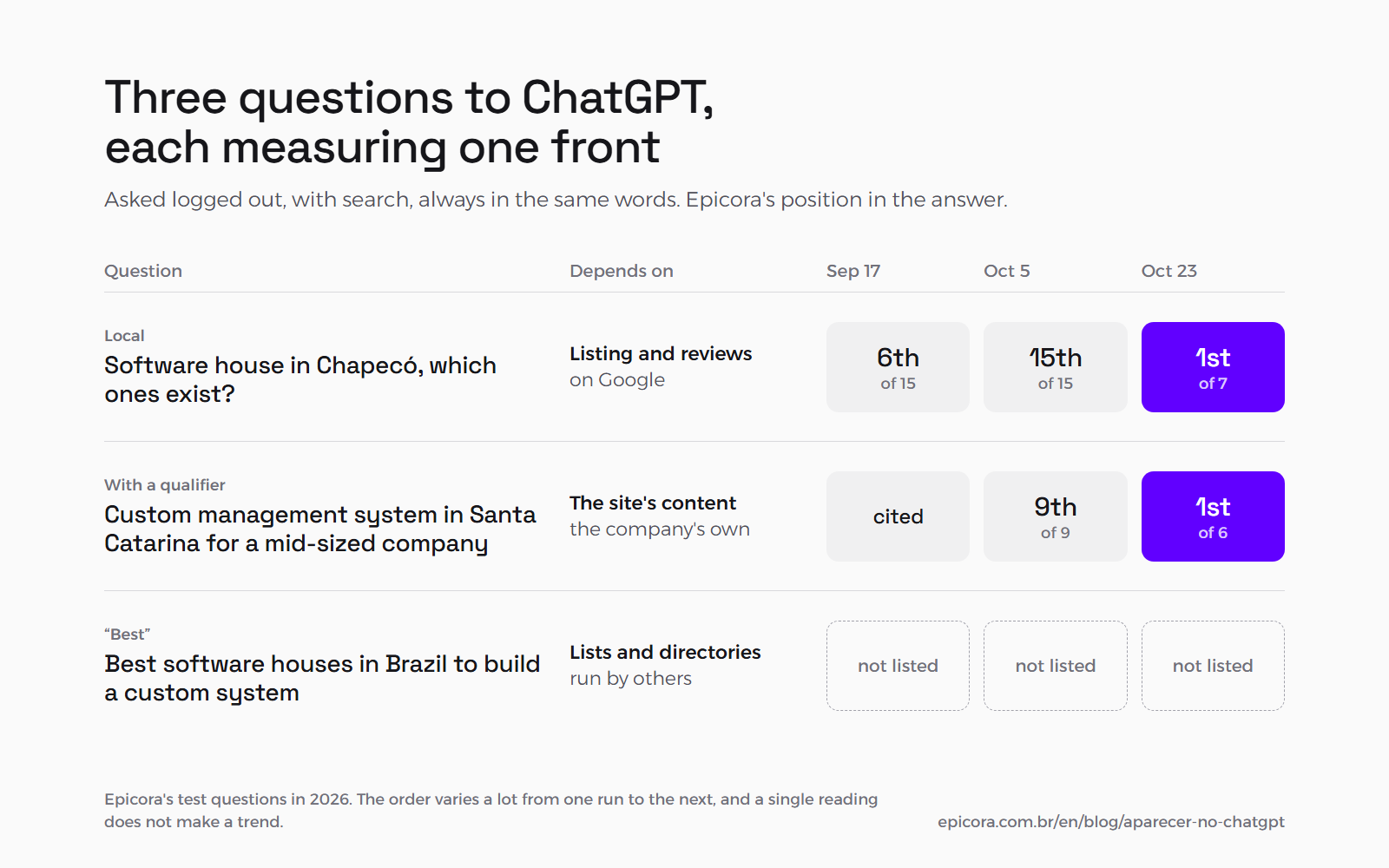
For the local question, the answer opens with a block of companies and the rating of each. On September 17, Epicora was 6th out of 15 in that block. On October 5, it was 15th, with the same 5.0 rating and the same 11 Google reviews. From October 16 on it was back in 1st place, still with the same 11 reviews, and on October 23 it was 1st out of 7, with a link to the site. With the same listing, the position went from 6th to 15th to 1st in a little over five weeks: the order of the block varies a lot from one run to the next, and a single reading does not make a trend. What the listing decides is getting into the block. For the position, what Google says about local search, in Google Business Profile Help, is that more reviews and positive ratings can improve a business's ranking.
For the question about custom management systems for mid-sized companies in Santa Catarina, our home state, the answer draws on the content of company sites. On October 5, Epicora was 9th out of 9, with a link; on October 23, it was 1st out of 6, also with a link to the site.
The work outside the site is listing and asking: a complete Google Business Profile, a review requested after each delivery, with no pre-written text, and listings in industry directories with the same name, registration number, address and description as the site, because the AI cross-checks these sources to confirm it is the same company. It also pays to fix old listings: until October, one directory still showed outdated details and a positioning we had dropped in August. Google's guide warns that chasing inauthentic mentions across the web isn't as helpful as it might seem.
How to measure whether AI is recommending your company#
You can measure it with three readings, always repeated the same way: the Generative AI report in Search Console, which counts how often the site appeared in Google's AI answers; the same questions asked to ChatGPT while logged out; and the AI assistant channel in Google Analytics. Measuring with ChatGPT logged in gives false results, because it uses the account's memory.
The Generative AI report in Search Console#
According to Search Console Help, since August 31, 2026 every site has the Generative AI performance report. It counts impressions, meaning the times a link to the site appeared in an AI Overviews or AI Mode answer, and breaks them down by page, country, device and date. The help page only describes impressions, not clicks.
On our site, these impressions, summed over 90 days, went from 262 in the August 26 measurement to 1,482 in the October 23 one, and the cited pages went from 41 to 96. In the 28-day window there were 902 appearances, against 367 in the previous 28 days. The daily average from October 15 to 21 was 61 appearances, against 35 in the seven days before, with a record of 84 on October 14. Month by month, the curve from May to August was 13, 30, 54 and 165 appearances, with May counted from the 25th and August through the 24th.
The country breakdown keeps you from celebrating too early. On October 23, 51% of the appearances in the previous 28 days came from Brazil, and much of the rest came from Spanish-speaking Latin America, where we do not sell yet.
The same questions, in ChatGPT while logged out#
ChatGPT has no report for companies. The way to measure is to ask the same questions, in the same words, every so often, and write down who appears and which sources the answer cites.
The question has to be asked without logging in. According to the OpenAI Help Center, with memory turned on ChatGPT may use what it saved about the user when rewriting the search. On one of our logged-in accounts, the question about the best software houses in Brazil brought up Epicora in the form "if I were mapping the market for Epicora", which is the memory talking. Search works without logging in, and the approximate location comes from the IP address, so it helps to write the city or state in the question.
We use three questions, one of each kind (asked in Portuguese; translated here):
| Question to ChatGPT, logged out, with search | 09/17/2026 | 10/05/2026 | 10/23/2026 |
|---|---|---|---|
| Software house in Chapecó, which ones exist? | 6th of 15 in the local block | 15th of 15 | 1st of 7, with a link to the site |
| Who builds custom management systems in Santa Catarina for mid-sized companies? | cited, with a link to the site | cited, with a link, 9th of 9 in the text | 1st of 6, with a link to the site |
| Which are the best software houses in Brazil to build a custom system? | does not appear | does not appear | does not appear |
Each question measures one front. The local one depends on the business listing and its reviews. The one with a qualifier, such as "custom", "in Santa Catarina" or "for mid-sized companies", depends on the site's content. The "best" one depends on lists and directories. With the three side by side, you can tell which front is stuck.
In Google Analytics, visits from ChatGPT show up in the AI assistant channel because, according to OpenAI, ChatGPT tags the link with utm_source=chatgpt.com.
What doesn't work to show up in ChatGPT#
Paying to get into the answer doesn't work, and neither does publishing an llms.txt and waiting, rewriting the site in chunks for the crawler or trusting a tool that promises rankings. Measuring with ChatGPT logged in is no use either. All of this costs money or time without changing what the AI reads about the company.
ChatGPT has shown ads in Brazil since August 2026, according to OpenAI. The ad is labeled as sponsored and kept separate from the answer, and the rule OpenAI states is that ads do not influence what the answer says. A service that promises to put your company in ChatGPT's answer cannot deliver that through ads.
llms.txt is a 2024 proposal by Jeremy Howard for a file at the root of a site that summarizes its content for an AI agent to consult. The proposal's site does not say any search engine uses the file to build answers, and Google's guide says its search does not use llms.txt. We have one, and the site serves its text as Markdown when an agent asks for it. They serve the agent that browses the site to carry out a task, and none of the citations we measured can be credited to them.
The same guide says there is no need to break text into chunks, to write in a special way for AI or to create a page for every variation of the question. Doing that at volume to manipulate the answer is, under Google's rules, scaled content abuse. The direct answer we use at the start of each section stays because it serves the reader who arrives through a single passage.
Structured data, the code that describes the company to machines, is not a requirement either, according to Google. And a tool that promises rankings deserves suspicion: Google says no third-party tool has access to its internal systems.
Why being cited is not yet being contacted#
AI answers the question on its own screen, and few people click through to the source. On our site, appearances in Google's AI answers more than doubled over 28 days in the October 23 measurement, and clicks did not follow: search brought 68 clicks, against 82 in the previous period, and no real contact has come through the site since October 16. What brought the distant lead was the AI naming the company in its answer.
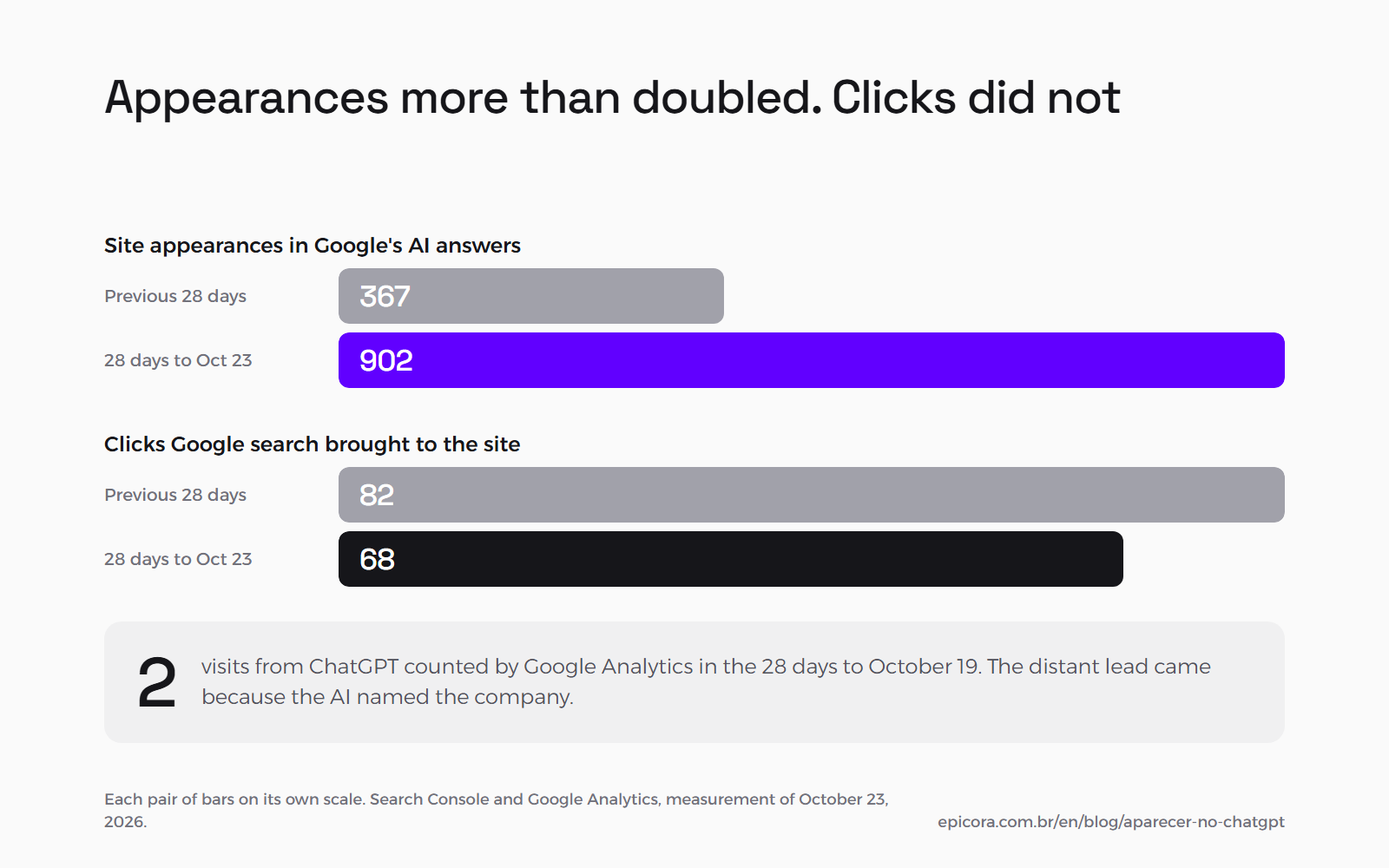
In the October 23 measurement, the site had 902 appearances in Google's AI answers over 28 days, against 367 in the previous 28. In the same period, Google search showed the site 5,215 times and brought 68 clicks, against 82 in the previous 28 days. Visits from ChatGPT are rarer still: Google Analytics counted 2 in the 28 days to October 19.
And there is the gap that only shows up when someone tests. On October 16, in a test submission, we found that the contact form on our own site was broken: whoever submitted it saw an error message, and the email never arrived. There was no way to know since when, because the server logs keep only one week. The fix went out the same day, together with a daily check that raises an alert when submission fails, and the story is in the contact form that broke without anyone noticing. Before concluding that AI brings visibility but not contact, it is worth checking that the path to contact works.
Part of the gap doesn't show up in any report. The contacts who, in August, told us they came from ChatGPT reached us by WhatsApp and by email, and we only knew the origin because they said so. The origin of the manufacturer 900 km away also came from the conversation. And Google Analytics only counts visitors who accepted cookies, so every visit figure is a floor.
That is why it pays to ask every new contact how they found the company, and to record the answer. It also pays to look after the page the AI cites: it needs a short path to contact and an answer to the buyer's next question, which is usually how much it costs and how long it takes.
Frequently asked questions#
Can a company pay to appear in ChatGPT's answer?#
No. ChatGPT has shown ads in Brazil since August 2026, but they are labeled as sponsored and kept separate from the answer, and OpenAI states that ads do not influence what the answer says. A company gets into the answer when its own site and third-party sources answer the question the person asked.
Does llms.txt help a company show up in ChatGPT?#
Not on its own. llms.txt is a proposed file for AI agents to consult, and the proposal's site does not say any search engine uses it to build answers. Google says its search ignores the file. We have one on our site, for the agents that browse it, and we do not credit it with any of the citations we measured.
Does blocking GPTBot take a company out of ChatGPT?#
No. According to OpenAI, GPTBot collects content to train its models, and the bot that decides whether a site appears in ChatGPT search is OAI-SearchBot. A site can block the first and allow the second. If OAI-SearchBot is blocked in robots.txt, the site does not appear in ChatGPT search answers.
How do I know whether ChatGPT is recommending my company?#
Ask the same questions every so often, logged out, and write down who appears and which sources the answer cites. When you are logged in, ChatGPT can use the account's memory and show your company because it knows who you are. For Google, the Generative AI report in Search Console counts how often the site appeared in AI answers, by page and by country.
Do Google reviews help a company appear in ChatGPT?#
In our measurements, they help with the local question. ChatGPT's answer to the question about software houses in Chapecó opens with a block of companies and their ratings, built from Google business listings, and the listing is what puts a company in that block. The position inside it varies a lot: with the same 11 reviews, we went from 6th place on September 17 to 15th on October 5 and back to 1st from October 16 on. What Google itself says about local search is that more reviews and positive ratings can improve a business's ranking.
Sources#
- Google Search Central, optimizing your website for generative AI features on Google Search, updated July 10, 2026 (first-hand content; retrieval from the Search index with the core ranking systems; no need for llms.txt, chunking or special markup; scaled content abuse; inauthentic mentions and third-party tools): https://developers.google.com/search/docs/fundamentals/ai-optimization-guide
- Google Search Central, AI features and your website (indexed pages eligible for a snippet, and query fan-out): https://developers.google.com/search/docs/appearance/ai-features
- Search Console Help, Generative AI performance report (what an impression is, the dimensions and the rollout to all sites on August 31, 2026): https://support.google.com/webmasters/answer/16984139
- Google Business Profile Help, tips to improve your local ranking (reviews and local ranking): https://support.google.com/business/answer/7091
- Google Search Central, build and submit a sitemap (when Google uses the last-modified date): https://developers.google.com/search/docs/crawling-indexing/sitemaps/build-sitemap
- OpenAI, overview of OpenAI crawlers (OAI-SearchBot, GPTBot and ChatGPT-User): https://developers.openai.com/api/docs/bots
- OpenAI Help Center, Publishers and Developers FAQ (appearing in ChatGPT search and
utm_source=chatgpt.com): https://help.openai.com/en/articles/12627856-publishers-and-developers-faq - OpenAI Help Center, Searching the web with ChatGPT (query rewriting, memory, location and use without logging in): https://help.openai.com/en/articles/9237897-chatgpt-search
- OpenAI, "Testing ads in ChatGPT", update of August 11, 2026 (ads in Brazil, separate from the answer): https://openai.com/index/testing-ads-in-chatgpt/
- llmstxt.org, the llms.txt proposal: https://llmstxt.org/
- Muck Rack, "What Is AI Reading?", May 2026 edition: https://muckrack.com/blog/what-is-ai-reading-may-2026
- Vercel and MERJ, "The rise of the AI crawler", December 17, 2024: https://vercel.com/blog/the-rise-of-the-ai-crawler
- IndexNow, FAQ (participating search engines): https://www.indexnow.org/faq
Next step#
If your site does not appear when a buyer asks AI who can solve their problem, we start with the same reading we run on our own: the Search Console report, the logged-out questions and what the site delivers to the crawler. It is part of our work on company websites and landing pages, and the Sistema Forja case study is one of the pages on our site that AI cites most.
Want to look at this in your case?
Tell us in a few lines what you have today. We reply with the path that makes sense, even when the answer is not to build anything.