
The platform decision for a company website in 2026 is no longer builder versus custom: it is AI generator versus professional development. We no longer recommend a site builder for any new project, and for a small site with no personal data and no search as a sales channel, an AI generator is enough. The case leaves the generator the day someone becomes accountable for performance, SEO, GEO, AEO, security and data protection.
Why the "Wix or custom" comparison aged out#
Anyone researching a platform for a company website gets almost the same comparison every time: site builder (Wix, Squarespace, WordPress) against custom development. That comparison aged out, and development is not what killed it. The AI generator did.
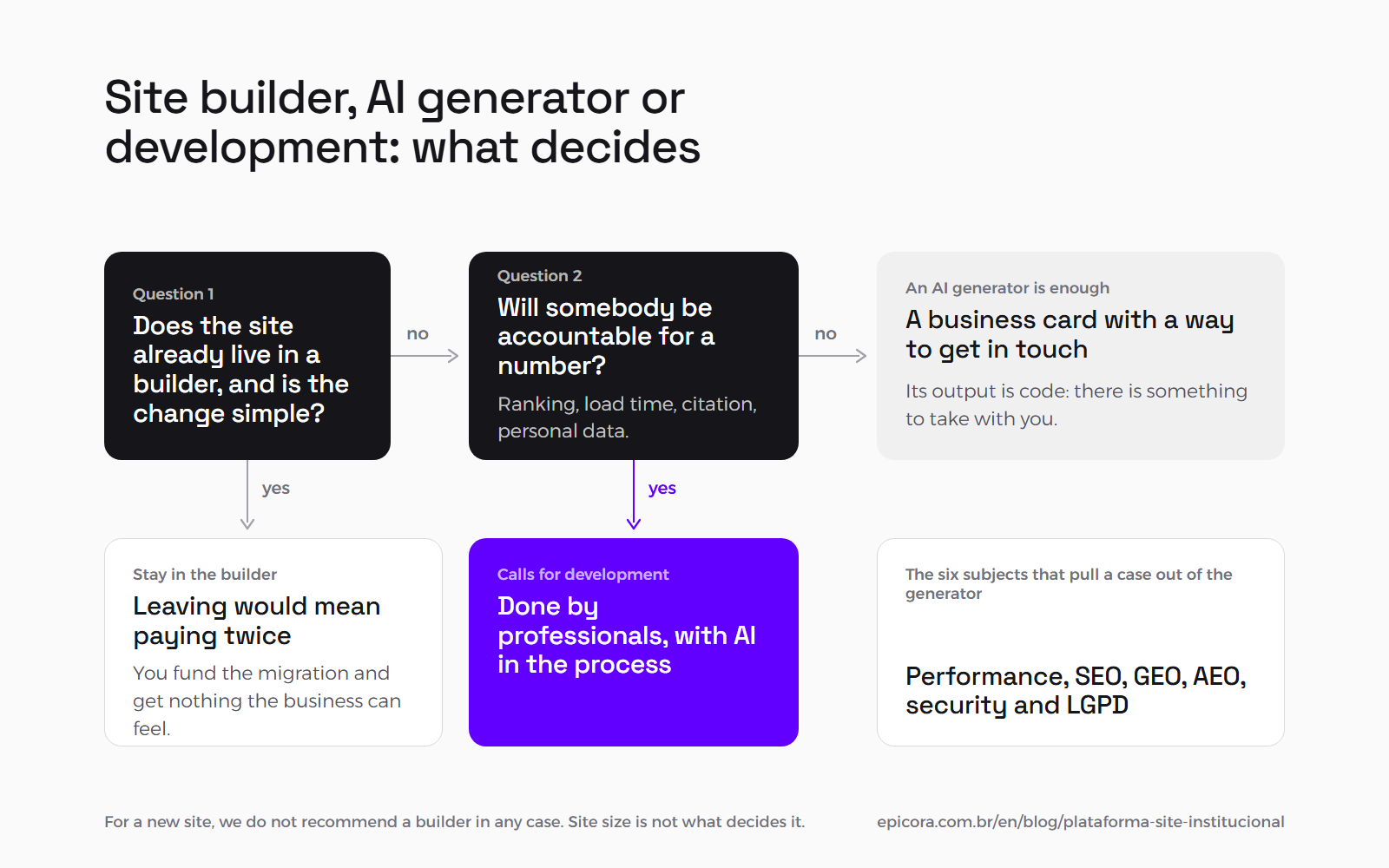
We no longer recommend a site builder for any new project. One scenario survives, and it is narrow: a very simple change to a site that already exists and already lives in a builder.
Outside it, the bottom rung changed hands. AI generation platforms (Lovable, Vercel's v0 and the like) do what the builder did, land closer to what was asked for, and do not tie the layout to a platform subscription. The 2026 decision is a different one: AI generator or professional development. The criterion that separates the two is the subject of this article. If your site or app already lives in an AI builder and you want to know whether it needs to leave, the signs are in when an app built on Lovable needs to leave Lovable.
The search that prompted this article#
Over 28 days, from 10/08 to 06/09/2026, we tracked the queries for company website setup, company website and company website platform in Search Console. All three have people searching every month, and what comes back as an answer is a tool comparison, not a decision criterion.
People are asking exactly this, and we were not answering. Whoever searches for "platform for a company website" has already decided to have one: they are choosing where. That person does not need one more tool comparison, they need a criterion.
When a site builder still holds up#
One scenario, and only one: the site already exists, already lives in a builder, and the change is simple. Swapping a paragraph, uploading a photo, fixing an opening hour, publishing a page inside the theme that is already there. Leaving the builder in that situation is paying twice: you fund the migration and get nothing the business can feel.
What does not hold up is the reverse, and it is the common case: opening a brand new site in a builder because "it is the easy option". The bill arrives years later, in the material nobody owns.
When we rebuilt the site of Agência OKSE, in August 2026, the old WordPress carried two inheritances of that kind. Its ten portfolio URLs returned 404 while still listed in the sitemap and linked from the home page, because the content type had fallen out of the registry. And the sitemap indexed eight fictional team profiles from the theme itself, with invented names, live since 2019. That is what a builder theme accumulates when the site belongs to everyone and to no one.
When an AI generation platform is enough#
Saying this plainly is worth more than selling: for a wide band of company websites, the AI generator solves it.
It is enough when the site is, in practice, a business card with a contact path. Few pages, content that rarely changes, no integration, no login, no personal data beyond what a contact form receives, and no expectation of being found by category searches (only by the company's own name). If the goal is to exist at an address of your own with a contact button that works, the generator delivers that in an afternoon, and buying development for it is spending in the wrong place.
The structural difference from a builder is why the rung changed hands: the generator's output is code, so there is something to take away. A builder creates platform lock-in. A generator creates a starting point.
The limit is just as clear: the generator delivers the first version, not the foundation. In an app with 1,312 paying users that we audited, all eight server endpoints accepted unauthenticated requests, and the code did exactly what it had been asked to do. Nobody asked for the boundary, and the AI does not ask. A company website has a far smaller surface, and the mechanism is identical, described in what can be salvaged from AI-generated code.
The six subjects that pull a case out of the generator#
Six subjects push a case towards development done by professionals, with AI in the process: performance, SEO, GEO, AEO, security and data protection. None of them is page count or taste in design.
Performance. What counts is the field number, measured on a phone with throttled network and CPU. web.dev defines good LCP as up to 2.5 s, and that is what gets audited. A generator does not measure, and nobody warns you when the hero image started weighing 400 KB.
SEO. Real text in the HTML, one title and one description per page, correct canonical, reciprocal hreflang when there is more than one language, and a sitemap that describes reality (not ten URLs answering 404). It is hygiene, and hygiene is somebody's job.
GEO and AEO. Readiness for AI search is technical before it is editorial: robots.txt allowing AI crawlers by name, JSON-LD per page, and the text present in the raw HTML, because AI crawlers do not execute JavaScript. On our site that means 12 crawlers allowed by name.
Security. The technical audit we ran on our own site on 24 July 2026 found a two-year HSTS in place and, at the same time, CSP, X-Content-Type-Options, frame-ancestors, Referrer-Policy and Permissions-Policy missing. A generator puts none of that in, and none of it shows up on screen.
Data protection. The law we work under, Brazil's Law 13.709/2018 (LGPD), demands a decision no platform makes for you: who the data controller is. On the OKSE site that decided architecture. The privacy policy names OKSE as the controller, so GA4 and GTM were created inside the agency's own Google account, with our access: an asset that accumulates history or identity stays in the client's account, plumbing a successor could swap in minutes stays in ours. And consent has to actually work: in our audit, with no consent given, GA4 does not load, Hotjar does not load and no cookie is set.
The criterion, in one table#
| Signal in the case | AI generator is enough | Needs development |
|---|---|---|
| Content | few pages, text that rarely changes | living content (schedule, price, locations, catalogue) that changes without rebuilding a page |
| Being found | being found by the company name is enough | category search is a sales channel: SEO, GEO, AEO |
| Performance | small site, visits arrive from direct links | the phone is the front door and somebody is held to the field number |
| Personal data | a contact form and nothing else | customer data, login, CVs, bookings, uploads |
| Compliance | the platform's stock policy will do | a named controller, measured consent, your own terms |
| Integration | none | CRM, ERP, payments, transactional email, WhatsApp |
| Lifespan | it will be rebuilt within a year | it will be maintained and evolved for years, by someone else |
| Risk | the owner carries it | somebody answers for security, headers, backup and access |
The table reads one way: an AI generator is enough for as long as nobody is accountable for what the site produces. The day somebody becomes accountable for a number (ranking, load time, citation, personal data), the case stopped being a generator case. Site size is not what decides it.
What we measured on our own site about AI discovery#
Over 90 days (7 June to 6 September 2026), Google's AI answers cited 56 distinct pages of our site, across 371 impressions. In 28 days there were 250, against 165 measured on 26 August: 77 more impressions and 10 more cited pages in 8 days. And the session arriving from an AI assistant is the best session the site gets: 100% engagement, 2 min 33 s and 9 pages per session, against 5.9 pages from organic search (small sample, 5 sessions in 28 days, with the same signal in four consecutive measurements). What makes AI recommend a company, and how to measure it without fooling yourself, is covered in how to get your business recommended by ChatGPT.
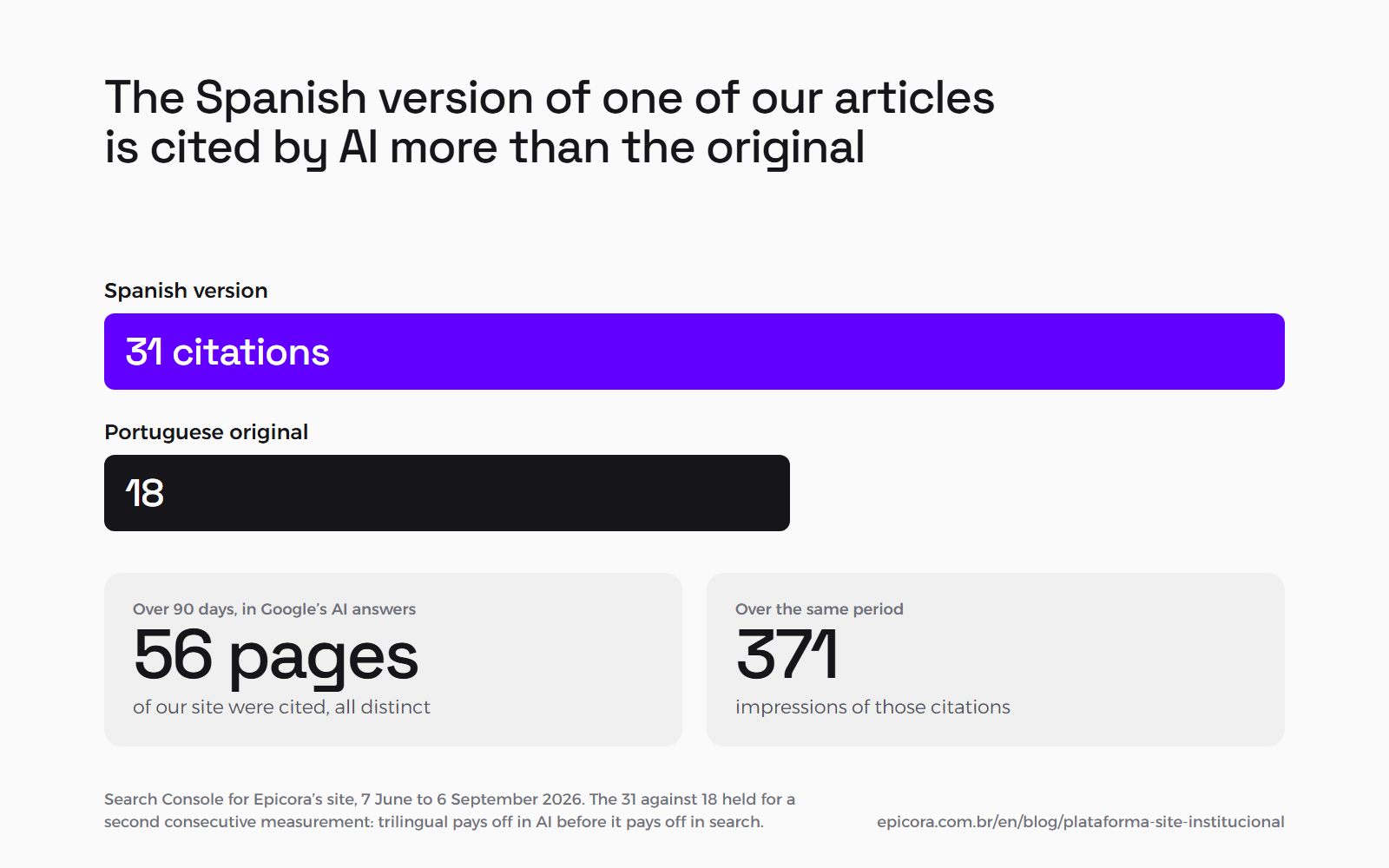
The finding that changed our platform rule is a different one: the Spanish version of one of our articles is cited by AI more than the Portuguese original, 31 citations against 18, for the second consecutive measurement. Trilingual pays off in AI before it pays off in search. Generating a single-language site throws that away, and in a builder the multilingual version is usually a paid plan or a plugin. In a code-built site, it is content structure.
Terms of use and privacy notice are among the most cited pages#
In our 90-day reading (7 June to 6 September 2026), /termos-de-uso took 15 AI citations and /aviso-de-privacidade took 8, above several of our service pages. It is not an accident: AI engines look for proof that the company exists and is serious, and a compliance page is exactly that proof, in text, stable and addressable. That is why data protection belongs in the platform criterion, not in the legal to-do list at the end of the project.
Frequently asked questions#
Is Wix or WordPress good enough for a new company website?#
We no longer recommend a site builder for any new project. One narrow scenario still holds: a very simple change to a site that already exists and already lives in a builder, where migrating costs money and returns nothing. For a new site, whoever used to pick a builder is better served today by an AI generation platform, which lands closer to what was asked for and hands back code instead of platform lock-in.
Can I start on an AI generator and migrate later?#
You can, and that is the generator advantage over a builder: the output is code, so there is something to take with you. Before migrating, check four things: whether the content is real text in the HTML rather than assembled by JavaScript, whether the domain and the analytics live in your own accounts, whether there are terms of use and a privacy policy of your own, and whether any form is writing personal data somewhere nobody has audited.
How do I know my case needs development instead of an AI generator?#
The shortest test is asking who is accountable for a number. If somebody will be held to mobile performance, ranking on category searches, citation by AI engines, security headers, backups or the legal basis for the data the site collects, the case needs development done by professionals, with AI in the process. If nobody will be held to any of that, the generator is enough and spending more is waste.
Is a code-built site automatically fast and well ranked?#
No. Built as code the site starts without the weight a builder theme carries, and that is where the advantage ends. Real speed depends on image weight, fonts, third party scripts and how many requests the page makes before it paints, and none of that is settled by the choice of stack: it is settled by somebody measuring in the field, at the 75th percentile, and cutting what is left over. Ranking is the same story, because search compares your page against the other answers to that query, not against your stack. What the platform decision guarantees is that there is somewhere to act when the measurement points at the problem.
Do I need an admin panel to update the site later?#
Almost never, and this is the question that inflates company website budgets the most. On the Bravio Combat Club site both class schedules live as data in the code, with a colour per class type and detail per group: updating a time slot means changing a value and publishing, and the schedule is already on its third version this year with no panel at all. A panel earns its place when the volume of change justifies maintaining one more system.
Sources#
- web.dev, Core Web Vitals (LCP threshold): https://web.dev/articles/vitals
- W3C, WCAG 2.2 (minimum AA contrast): https://www.w3.org/TR/WCAG22/
- Brazilian Law 13.709/2018, LGPD (data controller): https://www.planalto.gov.br/ccivil_03/_ato2015-2018/2018/lei/l13709.htm
Next step#
Read the Bravio Combat Club case, the club that only existed on Instagram and came to have its class schedule as content instead of an image. If your case falls on the right-hand side of the table, that is what we do in company websites and landing pages. And if you already have a site or product generated by AI and want to know what breaks before scaling, the exam is our vibe coding diagnostic.