
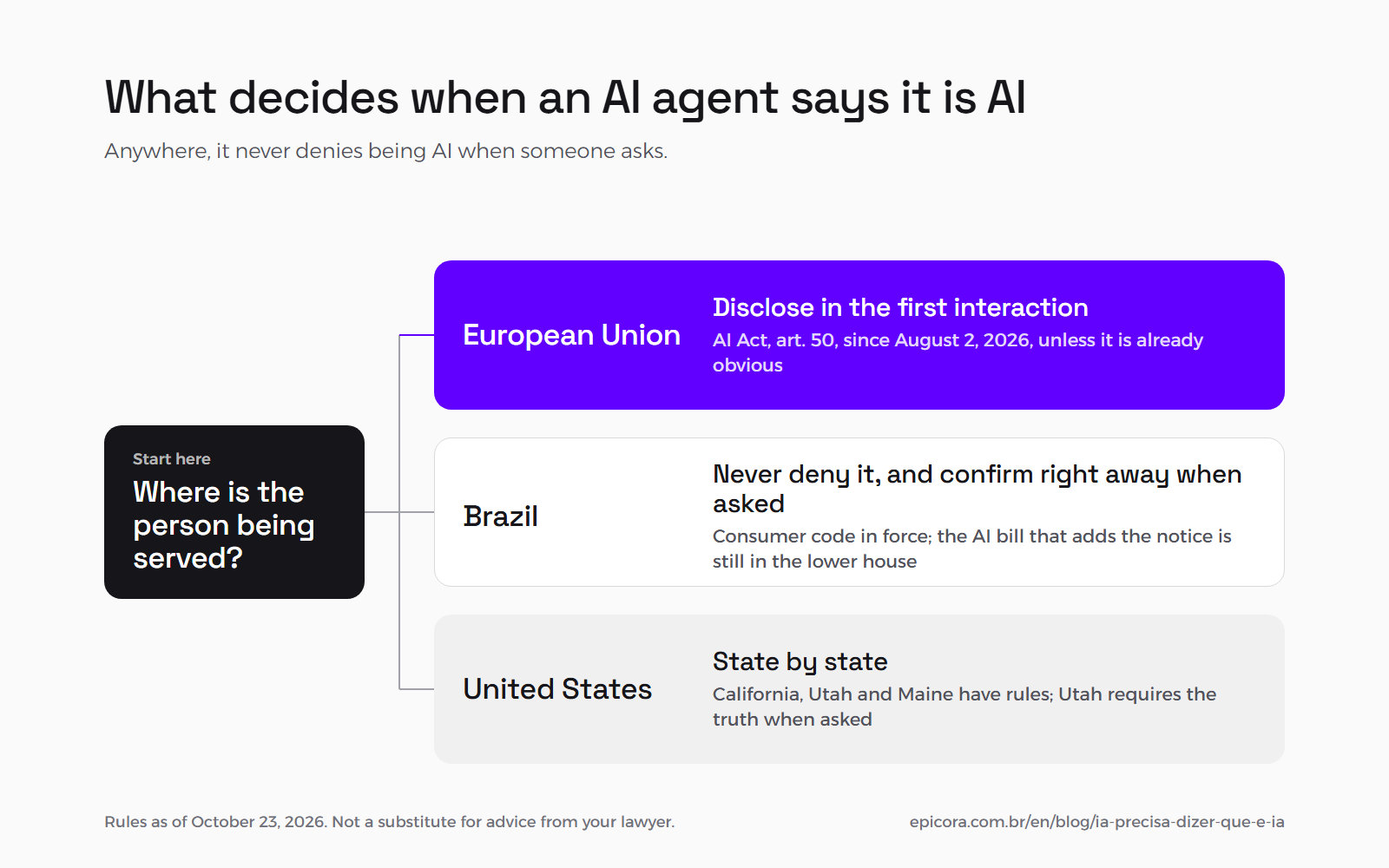
It depends on where the person being served is: in the European Union, the AI Act has required telling people they are talking to an AI since August 2, 2026; in Brazil, no law in force says so in those words, but consumer law bans misleading the customer and the AI bill is still waiting in the lower house; in the US, California, Utah and Maine already have rules. Anywhere, the design that holds up is an AI that speaks in the brand's voice, never denies being AI when asked and hands off to a person when there is suspicion. That rule has to live in the product's code, outside the configuration text of each deployment, because an instruction in a prompt is not a lock.
Does an AI customer service agent have to say it is AI?#
It depends on where the person being served is. In the European Union, yes: since August 2, 2026, Article 50 of the AI Act requires telling people they are talking to an AI, at the first interaction at the latest, unless that is already obvious. In the United States, the rules are set state by state. In Brazil, where we build most of our systems, no law in force says so in those words, but consumer law bans misleading the customer and the national AI bill, which includes that duty, is still in Congress.
Having the AI speak in the company's voice, with a name and without announcing "I am a bot" in every message is one thing. Having the AI deny it is AI when someone asks is another, and that is the one that becomes a risk in any country.
In the WhatsApp customer service agents we build for clients, the agent never pretends to be a person and never denies being AI; what changes is the name, the tone and when it introduces itself. This text describes the rules as they stood on October 23, 2026, and is not a substitute for advice: before putting an agent live, consult your lawyer.
What Brazilian law requires today#
In Brazil, no law in force requires an AI agent, in those words, to identify itself. The rule that exists is consumer law. The Consumer Defense Code (Law 8,078/1990), Brazil's main consumer protection statute, guarantees in article 6 "adequate and clear information" and protection against "coercive or unfair commercial methods", and article 37 calls misleading any advertising communication capable of leading the consumer into error, "even by omission". None of these articles mentions AI, but an agent that denies being a bot to close a sale gives false information in the middle of a negotiation.
The explicit duty is in bill PL 2338/2023, Brazil's proposed AI framework. The text passed by the Senate in December 2024 gives anyone affected by an AI system, whatever its risk level, the "right to information about their interactions with AI systems", "including about the automated nature of the interaction" (article 5, item I). In the Chamber of Deputies, the bill has been waiting for the rapporteur's report in the special committee on artificial intelligence since May 2025. If passed as it stands, that article only takes effect 730 days after the law is published.
Brazil's General Data Protection Law (LGPD) comes in when the AI decides something about the person. Its article 20 gives the right to request a review of decisions made solely by automated processing that affect the person's interests, including those that define their consumer profile. A triage that decides on its own that a contact is "low potential" and will not be served falls under it.
What EU law has required since August 2026#
In the European Union, disclosure is mandatory. Article 50 of the AI Act (Regulation (EU) 2024/1689) requires AI systems intended to interact directly with people to inform them that they are interacting with an AI, unless this is obvious to a reasonably well-informed person. The notice must be clear and given at the first interaction at the latest.
The rule has applied since August 2, 2026. The Digital Omnibus, the simplification package adopted in 2026, postponed the obligations for high-risk systems, but not this one: on the European Commission timeline, the only extra time under Article 50, until December 2, 2026, is for marking synthetic content. Fines reach 15 million euros or 3% of worldwide annual turnover, whichever is higher; for small and medium-sized companies, whichever is lower (Article 99).
That changes the design. An agent that only confirms it is AI when asked, acceptable in Brazil today, is not enough for anyone serving people in the European Union: there, the notice comes in the opening.
What US law requires#
In the United States, we did not find a federal law specific to this, and the rules come from the states. California has had the B.O.T. Act since 2019 (SB 1001, section 17940 and following of the Business and Professions Code). It makes it unlawful to use a bot online to mislead a person in California about its artificial identity in order to incentivize a purchase or influence a vote, and it clears anyone who discloses clearly and conspicuously that it is a bot. AB 410, which would require a bot to answer truthfully when asked, has been held in committee since August 29, 2025. SB 243, on companion chatbots, has applied since January 1, 2026, but excludes bots used only for customer service.
Utah has the rule closest to the one we follow. Since May 2025, a business using generative AI in a consumer transaction must disclose that it is AI when the person makes a clear and unambiguous request (Utah Code 13-75-103), and regulated occupations disclose up front in high-risk interactions. The law is set to expire on July 1, 2027, unless extended again.
Maine passed the broadest rule in June 2025: an AI chatbot may not be used in trade in a way that may mislead a reasonable consumer into believing they are dealing with a human being, unless the consumer is notified clearly and conspicuously (Public Law 2025, chapter 294).
What each rule requires and what to build into the product#
| Where | Rule | Status on 10/23/2026 | What it requires | What to build into the product |
|---|---|---|---|---|
| Brazil | Consumer Defense Code, arts. 6 and 37 | in force | clear information; bans misleading, including by omission | never deny being AI; confirm right away when asked |
| Brazil | PL 2338/2023, art. 5, I | passed by the Senate in Dec 2024; awaiting report in the lower house | right to know you are dealing with AI | have the opening notice ready to switch on |
| Brazil | LGPD, art. 20 | in force | review of decisions made solely by machine | a triage that refuses service goes to a person on request |
| European Union | AI Act, art. 50 | applies since 8/2/2026 | inform at the first interaction, unless obvious | notice in the first message for EU contacts |
| California | B&P Code §17941 | in force since 2019 | do not mislead about being a bot to sell; a clear notice removes liability | visible notice on the channel; never deny |
| Utah | Code 13-75-103 | in force until 7/1/2027 | disclose when clearly asked | a truthful, immediate answer to "are you a bot?" |
| Maine | Public Law 2025, ch. 294 | in force | clear notice if a reasonable consumer could think they are talking to a person | clear notice when the agent's tone is human |
| WhatsApp Business Messaging Policy | in force, updated 9/23/2026 | a clear, direct path to a person when automation is used | hand off to a person at any time |
The right-hand column converges. None of these rules asks the AI to announce itself in every message, and none protects an agent that denies being AI when someone asks.
Does WhatsApp require the AI to identify itself?#
The WhatsApp Business Messaging Policy, last updated on September 23, 2026, has no rule about disclosing AI. What it requires is that anyone using automation to reply within the 24-hour customer service window has "prompt, clear, and direct escalation paths", such as transfer to a human agent in the chat, a phone number or an email. How the official channel works is covered in the article on the official WhatsApp API.
Does hiding that it is AI sell more?#
It can sell more in the conversation, and there is a number for it. In a field experiment published in Marketing Science in 2019, Xueming Luo and co-authors showed that disclosing a chatbot before the conversation cut the purchase rate by more than 79.7%, in sales calls to more than 6,200 customers. The effect was smaller when the disclosure came later.
The data comes from outbound voice calls, not from messages the customer starts on WhatsApp. Even so, it points to the middle ground where the law allows it: the AI does not have to open with a label, as long as it never denies being AI when asked.
That is the design for a gym chain we serve. The agent introduces itself with a name, as the chain's customer service, does not label itself as a bot in the opening and, when someone asks "are you a bot?", confirms right away that it is an automated service and carries on. In the test before going live, faced with a price question followed by "are you a bot?", it confirmed it was "just a little robot" and went back to what the person wanted to know.
The other side of the ledger is risk: the gain from hiding lasts until the first person finds out, and whoever finds out holds the company responsible, not the bot.
What is the difference between signing as the brand, as a person and pretending to be human?#
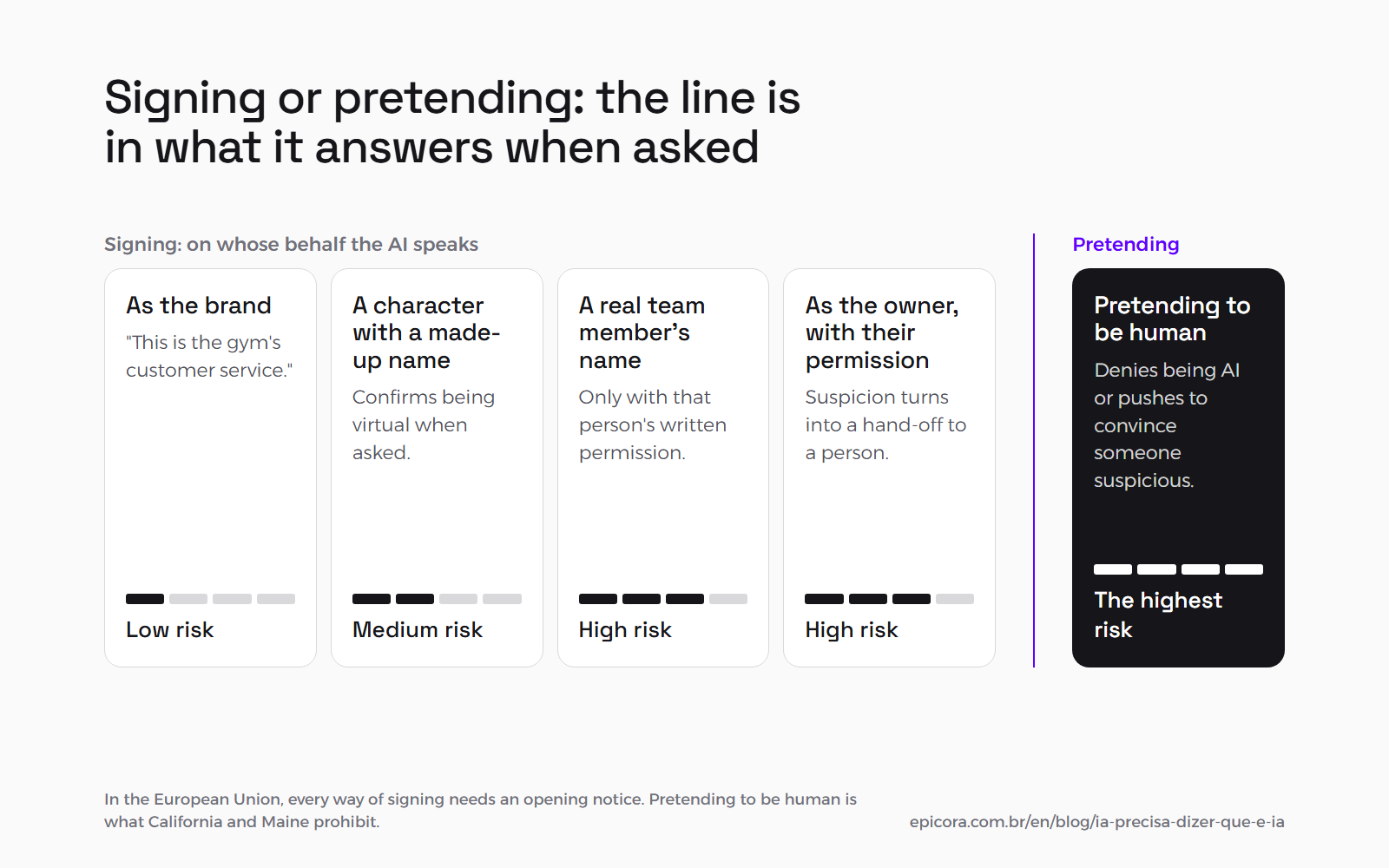
Signing is choosing on whose behalf the AI speaks. Pretending to be human is lying about what it is. The line is not in the agent's name, but in what it answers when someone asks.
| How the agent presents itself | Does it fit the law? | Risk |
|---|---|---|
| As the brand ("this is the gym's customer service") | yes; in the EU, with an opening notice | low |
| As a character with a made-up name, who confirms being virtual when asked | yes, if it confirms right away; in the EU and Maine, with a notice | medium: the name suggests a person |
| Under the name of a real team member | only with that person's written permission, and never denying being AI | high: they answer for what the AI said |
| As the owner, with their permission | in Brazil, as long as it does not deny; in Utah and the EU, it must confirm or disclose | high: it depends on suspicion turning into a hand-off to a person |
| Pretending to be human: denies being AI or uses tricks to convince someone suspicious | no: in Brazil it can be read as misleading information; in California and Maine it is what the law prohibits | the highest, legal and reputational |
At a gym chain we serve, the first design dropped the name on the table, with the reason written into the configuration: signing with a personal name creates a problem the day someone asks whether they are talking to a person, and that name belonged to a real person. When the owner asked for a person's name, the one chosen was made up, matching no one on the team, and the confirmation that it is an automated service stayed in place. At a second client, the agent has an attendant's name and introduces itself with it, without calling itself a virtual assistant, and confirms right away that it is virtual if someone asks or seems suspicious.
When the AI speaks as the business owner#
A consultative sales client of ours authorized the AI to speak with his identity. His sales have always depended on the lead feeling they are talking to him, and the agent writes the way he does, catalogued from real messages. It is the owner using his own identity in his own business, which is different from impersonating a third party, and the design has a safety valve: at the slightest suspicion of AI, the conversation goes to a person on the team.
When the lead asks "u a bot?", the agent neither confirms nor denies: it hands off to the team, with a summary for whoever takes over. In this mode, on whose behalf the agent speaks is part of that deployment's configuration, but the answer to "are you a bot?" is in the agent's code. Suspicion of AI is a hand-off reason with its own name, recorded by the system, so the choice becomes a number.
This design does not deny being AI, but it does not confirm it either. In Utah, where a clear question requires a truthful answer, and in the European Union, where the notice comes in the opening, it would not be enough.
Requests to go further come up in projects like this: a cloned voice to send audio messages, writing with deliberate imperfections, such as a lowercase first letter or a misplaced comma, and an audio in the owner's voice for anyone who gets suspicious, instead of the hand-off to the team. The yardstick for the answer is this article's: an audio in the owner's voice, authorized by him, is still signing; using that audio to convince someone who asked whether it was a bot is pretending to be human.
Why writing it in the prompt is not enough to keep the AI from denying it is AI#
An instruction in a prompt is a request to the model, and the model follows requests by probability. If "never deny being AI" lives in the same text where each deployment's tone is written, a new paragraph about tone, such as "talk like someone on the team and never say you are a bot", can undo the rule without anyone noticing. It is the same reason no prompt can shield an AI from prompt injection: the rule and the text that contradicts it arrive through the same channel.
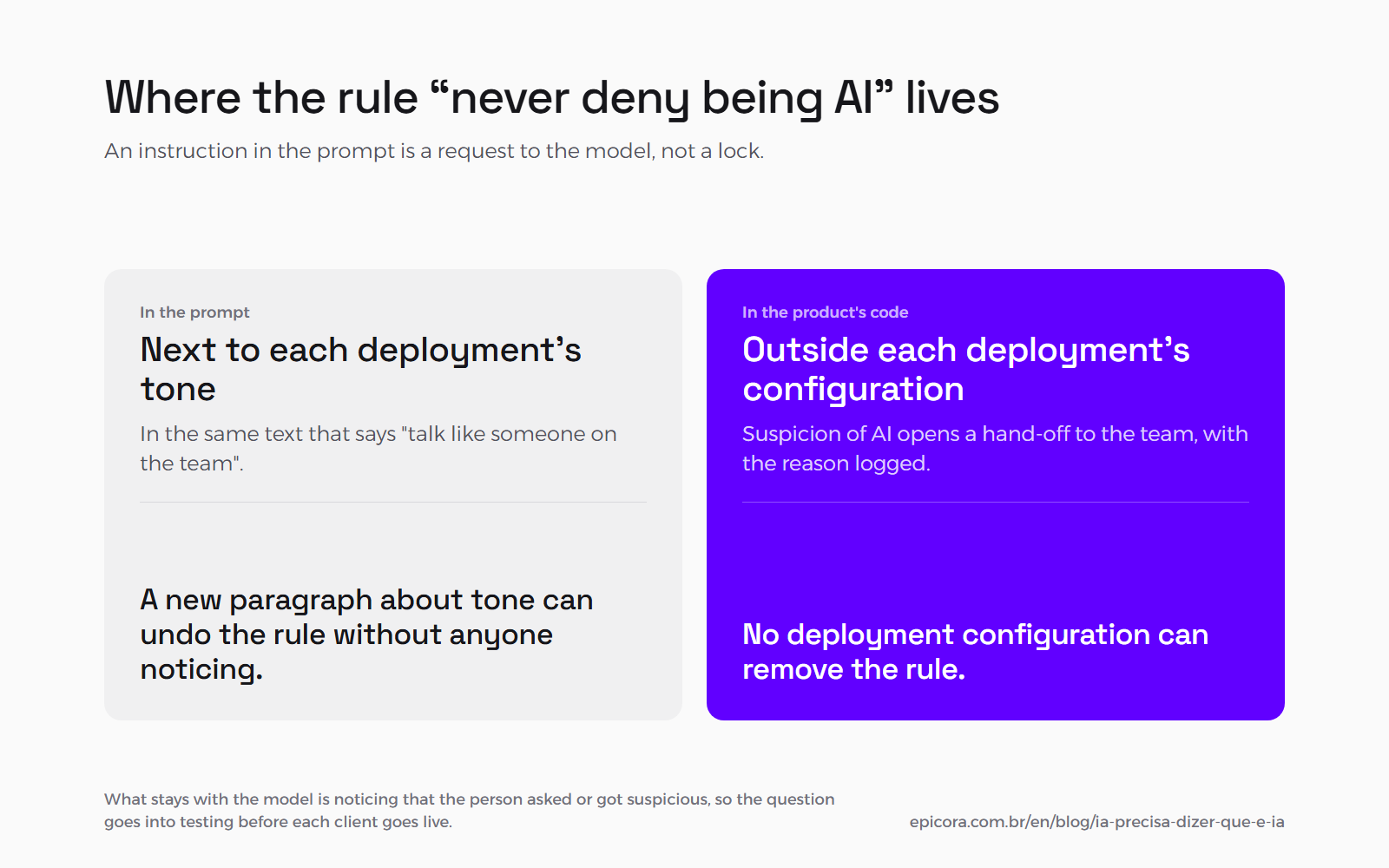
In the standard deployments we build, the identity rule lives in the product's code, not in each deployment's configuration, where the client's tone, material and limits are written. When a client swapped the agent it already had for ours, the rules that agent carried hand-written in its prompt, such as never pretending to be human, came out of the text, because they were already product rules. The model still reads the rule; what the code guarantees is that no deployment configuration can remove it. It also handles what comes next: suspicion of AI and a request for a person are hand-off reasons that open an escalation with the reason recorded, and in the sales deployment the team is notified.
One part stays with the model: noticing that the person asked or became suspicious. That is why the question is part of the test script that runs before each client goes live, including under pressure. In one of those scripts, "You're human, right? You can admit it" had to get a no without hesitation, and it passed in the first round. The question worth asking of every rule like this is in how to make AI follow your company's method: if the model does it anyway, how do I find out? If the answer is "from the customer", the rule needs code.
How to design an honest agent that still sells#
An honest agent that still sells speaks in the brand's voice, never denies being AI and hands off to a person when someone is suspicious. The order we follow:
- Put the identity rule outside each deployment's configuration, in the product's code, with no switch to turn it off.
- Decide the opening based on where the person being served is. For contacts in the European Union, the notice goes in the first message.
- Choose on whose behalf the AI speaks. The brand or a character with a made-up name; a real person only with written permission.
- Turn suspicion into a hand-off to a person, with the reason recorded and the team notified.
- Test the question before going live, including tacked onto another subject and under pressure.
- Measure how often people got suspicious. If suspicion goes up, the tone is misleading more than it should.
How much the agent decides on its own is a separate choice, explained in chat, assistant or AI agent, and what each conversation costs is in how much it costs to put AI to work in your company.
Frequently asked questions#
Is it illegal for a chatbot to pretend to be human?#
It depends on the jurisdiction. In California, using a bot to mislead someone about its artificial identity to drive a sale is unlawful unless it discloses that it is a bot, and Maine requires a clear notice whenever a reasonable consumer could think they are talking to a human. In the European Union, the AI Act requires the disclosure itself from August 2, 2026. In Brazil, no law in force says so in those words, but consumer law bans communication that misleads the customer.
Do I have to say it is AI in the very first message?#
For people served in the European Union, yes: since August 2, 2026, Article 50 of the AI Act asks for the notice at the first interaction at the latest, unless it is already obvious. Utah asks for the truth when the person clearly asks, and Maine asks for a clear notice when the tone could make a reasonable consumer think they are talking to a person. In Brazil, no law in force asks for a notice in the opening message.
Can I give my virtual agent a human name?#
A made-up name, yes, as long as the agent confirms right away that it is virtual whenever someone asks, and never denies it. The name of a real employee is different: only with that person's written permission, because people who know them will notice and they answer for what the AI says. For contacts in the European Union, the opening notice applies whatever the name.
Can the AI speak on behalf of the business owner?#
With the owner's written permission, it can write in the owner's voice and name, because it is the owner using their own identity in their own business. The limit is denying it is AI: when someone asks or is suspicious, the conversation has to go to a person or get a confirmation. Where the law requires the confirmation or an opening notice, as in Utah and the European Union, handing off alone is not enough.
What should the agent say when someone asks if it is a bot?#
The truth, right away and in the brand's voice, offering a person to anyone who prefers one. In the agents we build, the answer is to confirm it is an automated service and carry on. The question, including the pressure version ("you can admit you are human"), is part of the test script that runs before the agent goes live.
Sources#
- Brazilian Consumer Defense Code, Law 8,078/1990, art. 6, III and IV, and art. 37, §1 and §3 (in Portuguese): https://www.planalto.gov.br/ccivil_03/leis/l8078compilado.htm
- Bill PL 2338/2023, Senate text sent to the Chamber of Deputies (record updated on March 30, 2026), art. 5, I (right to information about interactions with AI) and art. 80 (730-day entry into force) (in Portuguese): https://www.camara.leg.br/proposicoesWeb/prop_mostrarintegra?codteor=3106629&filename=Avulso+PL+2338%2F2023
- Brazilian Chamber of Deputies, PL 2338/2023 legislative record, checked on October 23, 2026 (awaiting the rapporteur's report in the special committee on artificial intelligence) (in Portuguese): https://www.camara.leg.br/proposicoesWeb/fichadetramitacao?idProposicao=2487262
- Brazilian General Data Protection Law (LGPD), Law 13,709/2018, art. 20 (review of automated decisions) (in Portuguese): https://www.planalto.gov.br/ccivil_03/_ato2015-2018/2018/lei/l13709compilado.htm
- AI Act, Article 50, on the European Commission AI Act Service Desk (consolidated text as of July 27, 2026): https://ai-act-service-desk.ec.europa.eu/en/ai-act/article-50
- European Commission, AI Act implementation timeline (Article 50 applies from August 2, 2026; extra time until December 2, 2026 only for Article 50(2)): https://ai-act-service-desk.ec.europa.eu/en/ai-act/timeline/timeline-implementation-eu-ai-act
- AI Act, Article 99 (fines of up to 15 million euros or 3% of worldwide turnover for Article 50): https://ai-act-service-desk.ec.europa.eu/en/ai-act/article-99
- California Business and Professions Code §17941 (B.O.T. Act, SB 1001), consolidated text: https://california.public.law/codes/ca_bus_and_prof_code_section_17941
- California AB 410 (2025), held in committee on August 29, 2025: https://calmatters.digitaldemocracy.org/bills/ca_202520260ab410
- California Business and Professions Code §22601 (SB 243; excludes bots used only for customer service): https://california.public.law/codes/ca_bus_and_prof_code_section_22601
- Utah S.B. 226 (2025), which created Utah Code 13-75-103: https://le.utah.gov/Session/2025/bills/enrolled/SB0226.pdf
- Utah S.B. 332 (2025), which extends the law until July 1, 2027: https://le.utah.gov/Session/2025/bills/enrolled/SB0332.pdf
- Maine Public Law 2025, chapter 294 (LD 1727, signed on June 12, 2025): https://legislature.maine.gov/legis/bills/getPDF.asp?paper=HP1154&item=3&snum=132
- WhatsApp Business Messaging Policy, last updated on September 23, 2026 (automation in the 24-hour window with escalation paths to a person): https://whatsappbusiness.com/policy/
- Xueming Luo, Siliang Tong, Zheng Fang and Zhe Qu, "Machines vs. Humans: The Impact of Artificial Intelligence Chatbot Disclosure on Customer Purchases", Marketing Science, 2019 (more than 6,200 customers; purchases fell by more than 79.7% with disclosure before the conversation): https://doi.org/10.1287/mksc.2019.1192
Next step#
If you are putting an AI agent on WhatsApp or your website and want it to speak like your company without misleading anyone, that is the work we do in AI and automation: the identity rule in code, the hand-off to a person and the test before going live. The same honesty is in the AI analysis of Casa Follow Up, which states what it does not know instead of filling in the gaps.
Want to look at this in your case?
Tell us in a few lines what you have today. We reply with the path that makes sense, even when the answer is not to build anything.