
At Epicora, AI already handles five routine tasks: the daily meeting minutes, the weekly hours report, the first read of every code change, the scorecard of how the company shows up in search and the scope with a prototype before the quote. In all of them, the right way to do the job was written down before AI came in, a person decides what counts, and there is a lock: whatever is internal and reversible the AI does alone, and whatever goes outside or cannot be undone goes through someone. The minutes are the only thing it creates without asking.
 On video, in PortuguesePassei 5 tarefas da minha empresa pra IA (e o que eu não deixo ela fazer)16 min · YouTubeWatch on YouTube
What AI does at Epicora, and what it does not do without asking#
At Epicora, AI handles five routine tasks that used to belong to someone on the team: the daily meeting minutes, the weekly hours report, the first read of every code delivery, the scorecard of how the company shows up in search and the scope with a screen prototype before the quote. In only one of them does it write without asking for approval, and that is the minutes. In all the others, whatever leaves the company goes through a person first.
This article is the written version of the video Passei 5 tarefas da minha empresa pra IA ("I handed 5 tasks in my company to AI"), which I published on my YouTube channel, in Portuguese. Here are the numbers behind each task, where they come from and the test we use to pick the next one.
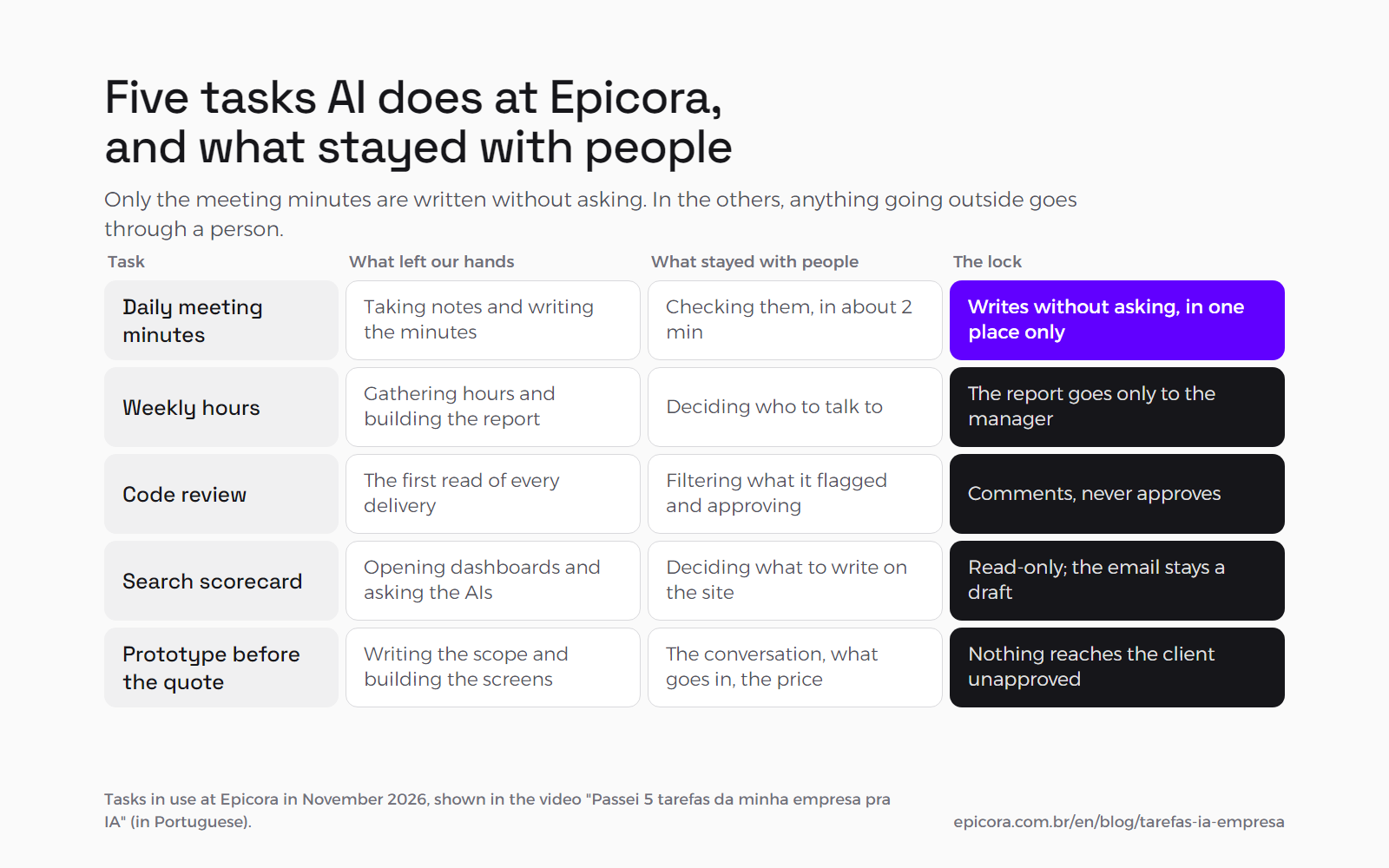
Each task answers the same three questions: what left our hands, what stays with people and what the lock is, meaning what the AI never does without asking.
| Task | What left our hands | What stayed with people | The lock |
|---|---|---|---|
| Daily meeting minutes | taking notes and writing the minutes | checking the minutes, in about two minutes | the only write the AI makes without asking, in one place |
| Weekly hours report | gathering each person's hours and building the report | deciding who to talk to and what to change | the report goes only to the manager; the message to the person stays a draft |
| Code review | the first read of every delivery | filtering what the AI flagged and approving the change | the AI comments and never approves |
| Search and AI scorecard | opening dashboards, asking the AIs and comparing with last week | deciding what to write and what to change on the site | read-only: no passwords, no changes to the site, the email stays a draft |
| Scope and prototype before the quote | writing the scope and building the screens | the conversation with the client, what goes into the system and the price | nothing reaches the client without someone approving |
Daily meeting minutes: the only task the AI does without asking for approval#
The minutes of our daily meeting have been written by AI since October 21, 2026, and they are the only write it makes without asking anyone. The meeting is recorded and transcribed, a routine reads the transcript and creates the minutes in our task manager, with who attended, what each person did, what they will do, what is blocked and the decisions with deadlines.
Before that, one person took notes of the whole meeting every day. It worked until the day that person could not join, because of illness, an appointment or a bad connection, and then the minutes were missing too. In September, with handwritten minutes, only 15 of 20 minutes had content.
The first step was not AI. It was writing down what good minutes look like for us, and the person kept writing them by hand, now following that standard. Only later did the routine start writing the minutes from the same standard. In a blind test with the meetings of October 19 and 20, the AI minutes captured decisions and deadlines that the handwritten minutes of the 20th had missed.
The lock is narrow. The AI is allowed to write without approval in a single place: the minutes list, with a fixed task name. That was allowed because the action is internal and reversible, since the recording and the transcript stay stored. What stayed with people is a check of about two minutes on what the transcript cannot know, such as who joined the meeting and stayed silent or a project name written wrong. The step-by-step of this routine is in meeting minutes with AI.
Weekly hours report: AI gathers the numbers and the conversation stays with the manager#
Since January 2026, everyone at Epicora logs hours against each task, in the same task manager where the tasks already lived. The data was there, but putting the hours together person by person took time nobody had, and the analysis kept getting pushed back.
Today an AI routine does it once a week, when the week closes. It starts one agent per person on the team, all at the same time, and each agent pulls that person's hours and builds the report by project. The result is one report per person and a reading of the week: where the time went, whether the hours are on the right projects and whether any task is missing its log.
The manager's job stopped being gathering numbers and became deciding who to talk to and what to change in the priorities. That is why there is a lock: the report goes only to the manager, not to the person on the team. The AI even drafts a message for each person, but the manager is the one who reads it, adjusts it and sends it. A conversation about someone's work needs context the report does not have.
Code review: AI does the first read and approves nothing#
Before a change goes into a client's system, someone on the team reviews the code of whoever wrote it. Reading someone else's code line by line is tiring, and tired people let things slip. We did not put AI in place of the reviewer; we put AI before the reviewer.
When someone delivers a new version of the code, the AI reads the change and comments on what could break, what is insecure and what does not follow our written standard. Between August 20 and September 28, 2026, across 26 deliveries in our projects, it flagged 51 issues, 4 of them security issues, all before the change reached the client.
Not everything it flags is useful. In the first week we measured after tuning the review to our in-house standard, the AI raised 13 points across 10 deliveries, and the reviewer kept 6. More than half was discarded, and that is by design: raising is the AI's job, filtering is the person's. The lock is that the AI comments and never approves; whoever releases the change is always someone on the team. What it catches and what slips through is in code review with AI.
The same idea works for people who do not write code: contracts, proposals and material that goes to clients can get a first read by AI against the company's standard, and the decision stays with whoever used to review.
Search scorecard: how to know whether the company shows up when someone asks an AI#
People looking for a supplier today ask Google and also ChatGPT, Gemini and Claude. We wanted to know whether Epicora shows up in those answers, and how often. Testing by hand works for a week or two, but nobody keeps the same method for months, and without it there is nothing to compare.
So it became a routine. On Mondays, Wednesdays and Fridays at 7 a.m., the AI opens the search and site analytics dashboards, reads the numbers, asks the AIs questions to see whether Epicora is cited and updates a scorecard with what changed since the last measurement. With that scorecard we adjusted the site and the blog, and our site's appearances in Google AI answers went from 262, in the August 26 measurement, to 1,482 in the October 23, 2026 one.
Along the way, a manufacturer from inland São Paulo, about 900 km from our office in Chapecó, reached out because ChatGPT recommended Epicora for the system it needed. The scorecard also shows the other side: showing up more did not turn into site contacts at the same pace. What we did on the site to show up is in how to show up in ChatGPT.
The lock here is read-only access. The AI does not know our passwords and does not log in to anything: the dashboards stay open in a controlled environment, and it can only view and extract the numbers. No information goes out, nothing on the site changes by its hand, and the summary email stays a draft for someone to send. What to write and what to change on the site is still a human decision.
Scope and prototype before the quote: what AI changed in sales#
The usual way to sell a system is a meeting, a PDF proposal and a leap of faith. The client only finds out whether it was the right thing at delivery, which is the most expensive moment to find out. For a long time we did it that way too.
Today the conversation with the client is still with people, and that is where we understand the business. What changed is what comes after: with AI routines that follow our method, the conversation becomes a complete scope, and the scope becomes the prototype with every screen and flow of the system. The client goes through it screen by screen, points out what is wrong and we adjust, all before receiving the quote. This stage costs the client nothing. Then comes the hours estimate, built on the projects we have already delivered.
What stayed with people is the conversation, the decision of what goes in and what stays out, and the price, which belongs to the sales team. The lock is that no document, screen or email reaches the client without someone approving it. Producing the first version of almost anything got cheap, and that makes it possible to show early what the client would otherwise only see at the end.
How to choose the first task to hand to AI#
Pick the first task by answering the same three questions the five Epicora tasks answer.
- What leaves your hands? It has to be something that comes back every week, or every day. A task that happens once a year does not pay for the effort of setting up the routine.
- What stays with people? Write down the name of whoever checks the result. If there is no name for this column, the task is not ready for AI yet.
- What is the lock? Say what the AI never does without asking, before it does anything.
In practice, the best candidate is a task you could teach to a new hire because it already has a right way of being done. Instead of teaching the person, you write down the problem, the result you want and the standard for the task, and ask the AI to build the routine. Start with the most organized process in the company, the one that has someone who knows it inside out, and sit with that person to describe it. Their time is what gains the most.
When AI can act on its own and when it needs approval#
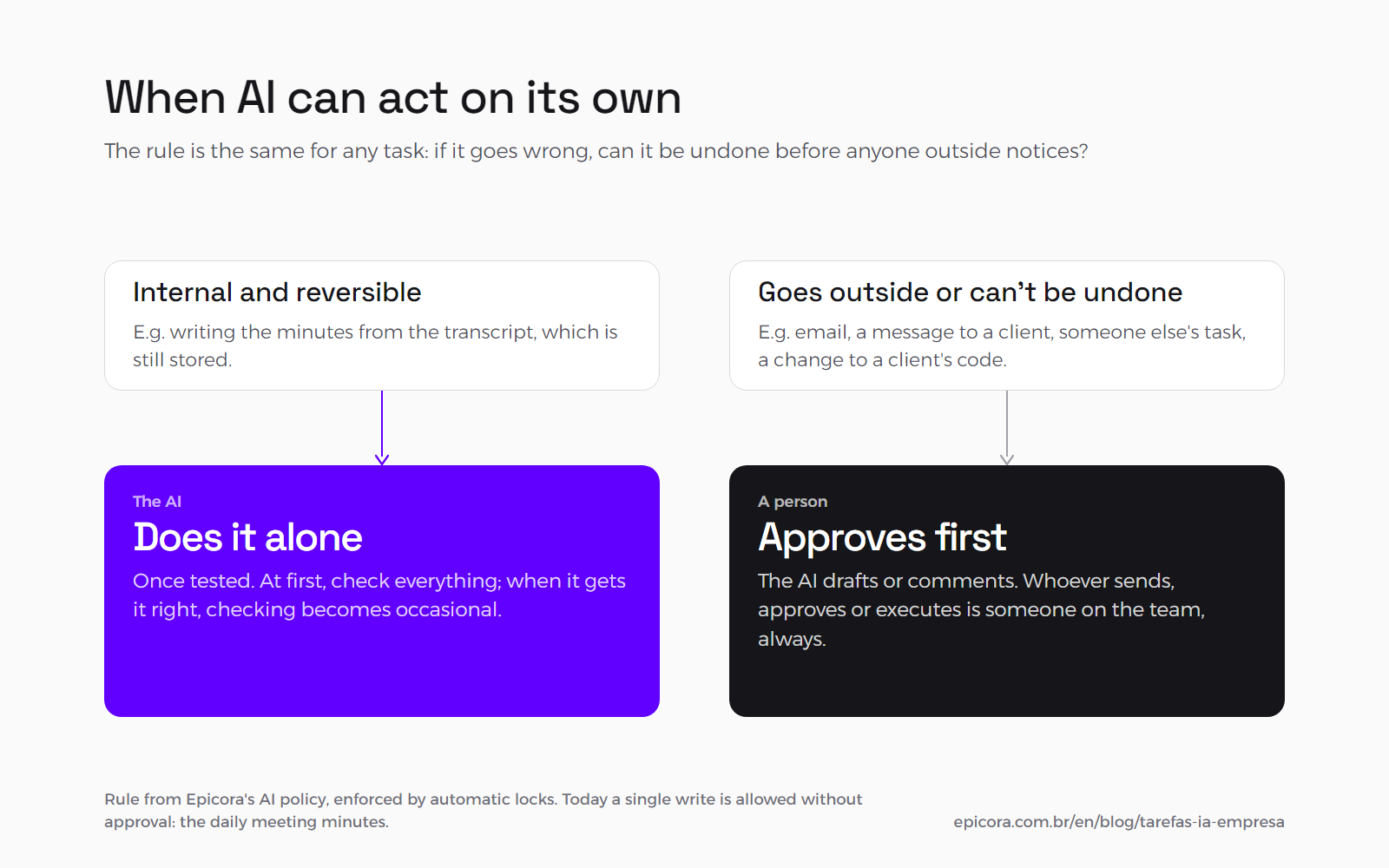
The rule we use fits in one line: whatever is internal and can be undone, the AI does on its own once tested; whatever leaves the company or cannot be undone goes through a person first. That rule is written in our AI use policy and enforced by automatic locks, not by the goodwill of whoever is using it.
| Type of action | What the AI does | Our example |
|---|---|---|
| Internal and reversible | does it alone, once tested, with occasional checks | writing the daily meeting minutes from the stored transcript |
| Internal, but about a person | prepares it, and the manager decides | hours report and the draft conversation with each person |
| Leaves the company | prepares a draft, and someone sends it | the scorecard email, documents and screens for the client |
| Cannot be undone | does not do it; a person decides and executes | approving a change to a client's code |
The testing part matters. At first, check all of the AI's work, as you would with someone who just joined. Once it gets things right, checking becomes occasional, and you stop spending time validating what is reversible. For what goes outside, human review stays for good. How to set up this policy is in AI that asks for approval.
Why the process has to be written down before AI arrives#
In all five tasks, the right way of doing the job was written down before AI came in: what good minutes look like, what the hours report looks like, how we review code, how a scope is written. The AI did not invent our process; it reads the process when it runs. Today 25 processes of our operation are written down as standards.
Without a written standard, every run comes out different and there is nothing to check against. If your task does not yet have its right way written down, start there, with whoever already does the task. How to organize that material for AI to use is in organizing company knowledge for AI.
There is a sixth task that did not make the list: the video itself. The idea became a two-minute voice note to the AI, and the first script was ready in under 20 minutes, with the numbers checked against our documents. What stayed with me was deciding what went in and recording it.
If you looked at the three questions and do not know where to start in your company, that is what we do in the Epicora diagnostic: we talk to the people who run the operation, map the flow and the numbers, and within a week deliver a map of what is stuck, how much it weighs and where to start. It is free, and the map is yours to keep. For what comes after, see how we work with AI and automation.
Want to look at this in your case?
Tell us in a few lines what you have today. We reply with the path that makes sense, even when the answer is not to build anything.