

Hiring a software development company works when the price arrives after a written scope and a prototype you have validated, not before. To compare proposals, compare what each one includes (scope, screens, integrations, data migration, warranty and ongoing support), not just the final figure. And three things go into the contract from day one: who owns the code, whose name the cloud, database, app store and domain accounts are in, and how long the warranty lasts, which at Epicora is three months after delivery.
What to ask for before you ask for a price#
Before the price, ask for the written scope: the list of modules, access profiles, business rules, integrations with other systems and the data that comes from spreadsheets or from the old system. Without that document, two proposals from different software development companies describe different systems, and the figure on each one does not tell you which is cheaper.
The conversation usually starts the other way around. The company describes its operation in a one-hour meeting and asks for a number. Whoever answers with a figure in the same week is guessing, and the guess has two outcomes: too high, to cover what they did not understand, or too low, and the difference comes back later as a change order or as a cut in quality.
The scope also reveals what may not need to be built at all. In an audit we ran in August 2026, three of a client's four requests already existed in the off-the-shelf software they were paying for, switched off or set to zero. That kind of finding only shows up when someone walks through the operation before quoting, and the checklist for that review is in off-the-shelf or your own system.
For a custom system, a good scope answers these questions:
- Who uses the system and what each profile can see and do.
- Which business rules the system applies on its own, such as approvals, calculations, deadlines and alerts.
- Which systems it talks to, such as the ERP, the financial system, WhatsApp and the app stores, and what each one lets out.
- Which data comes from where, and whether there is history to migrate.
- What stays out, written as clearly as what stays in.
Why you should see the screens before signing#
Because the screen is where the scope becomes something the people who operate it can judge. A list of modules looks complete until the person who will use the system every day sees the screen and asks where the field they fill in on the spreadsheet today has gone. That kind of adjustment is cheap in a prototype and expensive in a finished system.
At Epicora, the high-fidelity prototype of the main screens is validated with the client before the hours estimate and the proposal, and the scope is revised with what the validation showed. The proposal comes afterwards, for a system both sides have already seen.
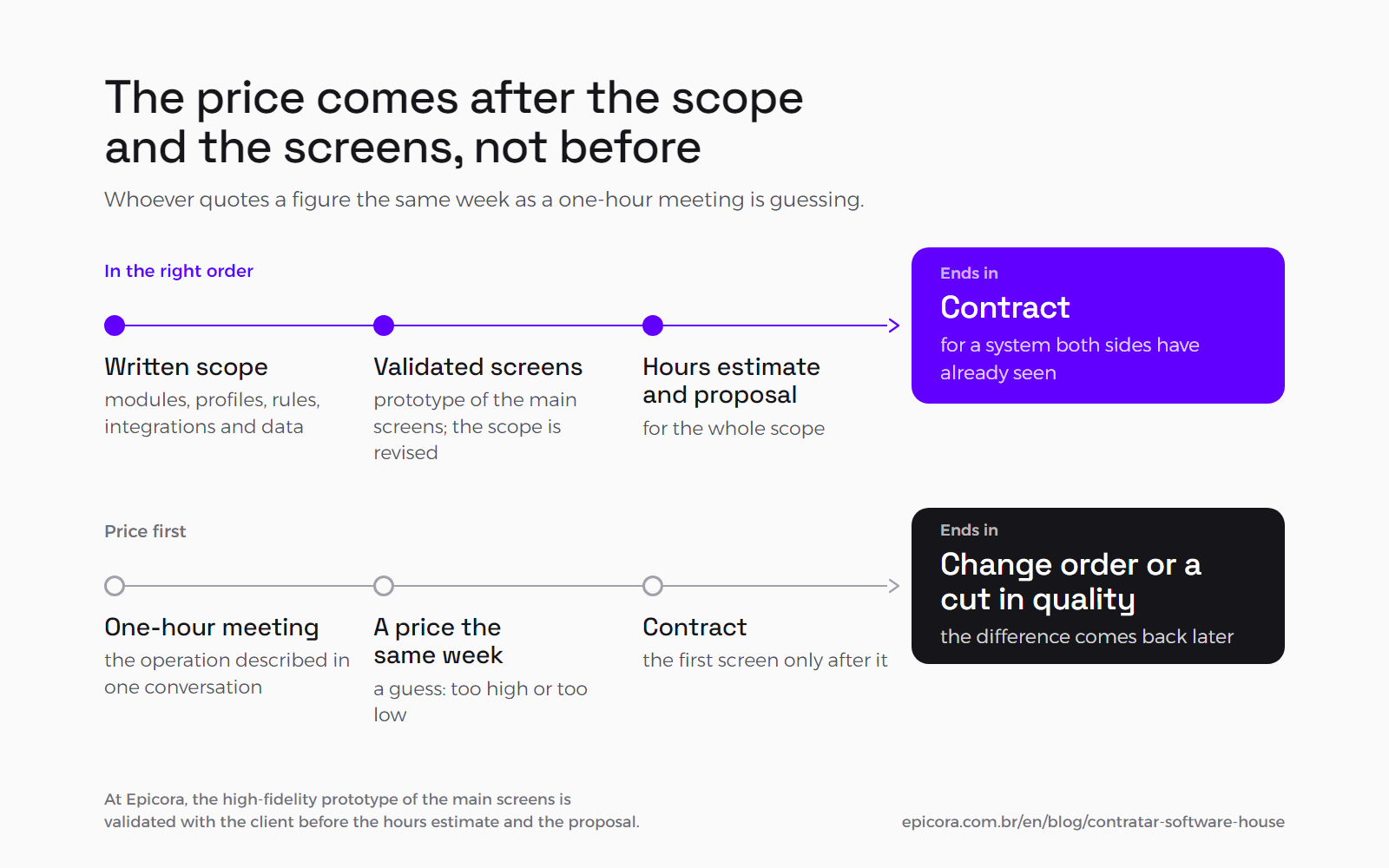
Asking to see the screens before signing also sorts software development companies by their process. A vendor that shows nothing before the contract will show you the first screen when much of the money has already been spent.
How to compare two proposals from software development companies#
Compare what each proposal includes, item by item, against the same scope. The final figure is only comparable when both cover the same screens, the same integrations, the same data migration and the same warranty after delivery.
| What to compare | Question to ask | Good sign | Warning sign |
|---|---|---|---|
| Scope | What is in and what is out, in writing? | list of modules, profiles and integrations, with what stays out | "complete management system" in one line |
| Screens | Will I see the screens before signing? | prototype validated before the proposal | first screen only after the contract |
| Integrations | Which systems does it talk to, and how does each one let the data out? | each integration named, with how it is read | "integrates with everything" |
| Data migration | Does the history from the spreadsheet or the old system come along? | migration in the scope, checked before going live | migration not mentioned |
| Deliveries | How and when do I see the system working? | short stages, each one validated | a single delivery, at the end |
| Accounts and code | Whose name are the repository, cloud, database, app stores and domain in? | all under the client's tax ID, vendor as a member | accounts in the vendor's name |
| Warranty | What is fixed at no cost, and for how long? | duration and coverage in writing | "we'll fix whatever comes up" |
| Ongoing support | Who keeps the system running afterwards, and what does it cost? | a service separate from the warranty, with its own scope | not mentioned, or mixed with new development |
| Proof | Which similar system is already in use, and who can I talk to? | case study with a named client and a real number | only a portfolio of screens |
The last row weighs more than it seems. A case study with the client named and the number of what changed shows that the system went into use. At Ideal Veículos, a network of 11 stores, the financing platform we built has already processed more than 11,000 financing deals, and at Beckers the inspection report app has issued 428 reports since it became part of the workshop's routine.
Who owns the system's code and accounts#
The code and the accounts the system runs on should be in your company's name from day one, with the software development company as a member. That applies to the repository, the cloud, the database, the developer accounts in the app stores and the domain.
The code is the part the law helps with. Brazil's Software Law (Lei do Software, Law No. 9,609/1998) says in art. 4 that, unless otherwise agreed, the rights to a program made under a service contract meant for that purpose belong to the client. The "unless otherwise agreed" is the reason to read that clause of the contract.
The accounts are the part the law does not settle. A system runs on a cloud, stores its data in a database and appears in the app stores through a developer account, and each of them has a holder. When that holder is the software development company, switching vendors depends on its goodwill. At Forja, a product built with AI that was already selling to 1,312 users, we finished the work by handing back 100% of the product running in the client's own accounts, as we tell in the Forja case study.
You can check this yourself, with a login of your own: the public lookup at Registro.br, the registry for .br domains, shows the holder of a .br domain, the cloud invoice should be issued under your company's tax ID, and in the app stores your company should own the developer account. What to ask for when the switch is already happening is in switching the company that maintains your system.
What the contract needs to say about warranty and ongoing support#
The contract needs to separate three things: the warranty, which fixes defects in what was delivered at no cost, for a written period; ongoing support, which keeps the system running afterwards; and new development, which is new functionality and has its own budget. When the three are mixed together, every bug becomes an argument about who pays.
At Epicora, the warranty lasts three months after delivery and covers a system that does not do what the scope agreed, or does it wrong. It does not cover new functionality or changes to business rules, and it no longer applies if another company alters the system.
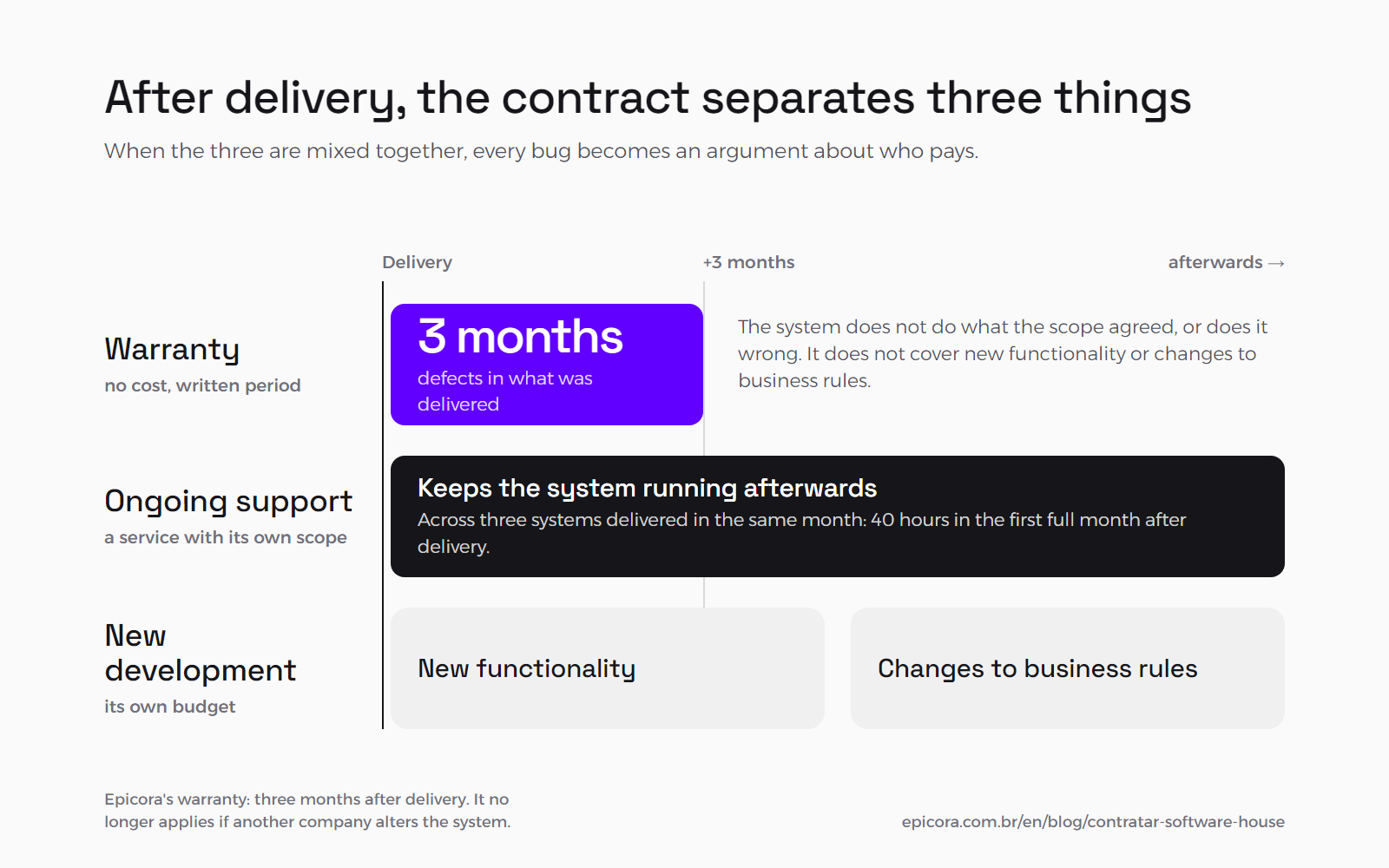
The work after delivery drops fast, but it does not end. Across three systems we delivered in the same month, the logged hours fell from 255 in the last month of development to 40 in the first full month after delivery. Those 40 hours are ongoing support and fixes, and it is better for the contract to say who takes care of them before they show up. The detail of each part is in what the warranty covers and what ongoing support is.
Signs it is worth looking for another software development company#
It is worth looking elsewhere when the price arrives before any question about the operation, when nobody shows a screen before the contract, or when the system's accounts would be in the vendor's name. Each of these signs shifts onto the buyer a risk the software development company should carry.
- A price at the first meeting. Without a written scope, the number describes no system at all.
- "We do everything" without a case study similar to yours, with a named client.
- No screens before signing.
- A single delivery, at the end, instead of stages you validate along the way.
- Accounts under the vendor's tax ID, or "we'll take care of that for you" without saying in whose name.
- A warranty with no time limit, or one that does not separate defects from new functionality.
- A promise to rewrite what you already have before anyone has diagnosed it. When we took over the GT platform, we fixed the 15 defects inherited from the previous vendor before developing the system further, and only then decided what was worth redoing.
And if the system you have today was built with AI, in Lovable or something similar, the first contract can be a diagnosis rather than a new system. That is the subject of when an app built in Lovable needs to leave Lovable.
Frequently asked questions#
How much does it cost to hire a software development company to build a system?#
It depends on the scope, so be wary of a price given before anyone understands the operation. A serious estimate is made in hours, per module, compared with similar projects the company has already delivered, and what weighs most is the number of integrations, business rules and access profiles, plus the migration of old data. Asking for the written scope along with the proposal is what lets you compare two figures.
What should I ask a software development company before hiring it?#
Five things: which similar systems it has already put into use, and whether you can talk to the client; what is and is not in the scope, in writing; whether you will see the screens before signing; whose name the code and the cloud, database, app store and domain accounts will be in; and what the warranty covers and for how long after delivery.
Hourly billing or a fixed price: which is better?#
For a system with a written scope and validated screens, a fixed price for the whole scope gives the buyer more predictability. Hourly billing makes sense for what cannot be described yet, such as an investigation or the ongoing evolution of a system that is already live. What does not work is a fixed price without a scope: someone will pay the difference, and it is usually paid in quality.
Does my company keep the system's code?#
It depends on the contract. Brazil's Software Law (Lei do Software, Law No. 9,609/1998) says in art. 4 that, unless otherwise agreed, the rights to a program made under a service contract meant for that purpose belong to the client. The "unless otherwise agreed" is the reason to read the clause, and, beyond the code, the accounts the system runs on need to be in your company's name.
How long does it take a software development company to deliver a custom system?#
The timeline comes out of the scope, along with the hours estimate. The sign of a good process is delivery in short stages, one to three weeks in our case, each one validated by you, with the first version in use long before the complete system and a planned buffer before the final date.
Sources#
- Brazil's Software Law, Law No. 9,609/1998 (Lei do Software), art. 4, on who owns a program developed under a service contract: https://www.planalto.gov.br/ccivil_03/leis/l9609.htm
Next step#
Before asking for the first proposal, write down who will use the system, which rules it applies, which systems it talks to and which data comes from where, and take the comparison table to every conversation. If what you need is to get the operation out of the spreadsheet or the old system, that is the work we do in custom systems, as with the Ideal Veículos financing platform.
Want to look at this in your case?
Tell us in a few lines what you have today. We reply with the path that makes sense, even when the answer is not to build anything.