
A service becomes a software product when each step of the method that lives in your head today (asking, calculating, deciding and alerting) becomes a rule the system applies on its own, and when it is written down what stays with you: judgment, content and the relationship with the client. In Sistema Cuidar, the 13-factor risk matrix is computed from the data, AI writes 5 of the report's 15 sections and the psychologist in charge reviews them before export. The work of turning a method into a product is designing this before coding, and sometimes what holds the launch back is not software at all, but company registration.
What it means to turn a service into a software product#
Turning a service into a product means having the system apply, on its own, the steps of your method that depend on you today: asking, calculating, deciding and alerting. The product is not the method's content on a screen, it is the rule applied to each client's data. And it is written down, from the start, what stays with you.
Personal trainers, psychologists, physical therapists, consultants and lawyers who sell a service with their own method serve clients up to the limit of their own hours. The method exists, but it lives in the professional's head: they know which question to ask, how to add up the answers, what each result means and when to call the client back. Productizing the service means writing each of those steps as a rule the system executes, for more people than you could serve alone. That is the work we do in digital products and SaaS.
That is why turning the method into a product is not digitizing the method's PDF. An app that shows your handouts and videos is content, and content competes with everything that is free on the internet. The product begins when the system does with your client's data what you would do: adds up the test answers, classifies the risk, detects that the student set a personal record, shows that the patient stopped answering.
A ready-made platform with your brand on top, known as white label, works for starting and validating. It gets stuck when the method becomes the differentiator and there is nowhere to apply your rule, as we show in white label app or your own app.
Three methods that became software#
In the three products below, which we built, the method belonged to the people who served the clients, and the system took over the part that repeats: training, psychosocial risk assessment and clinical follow-up. In all three, the professional remains at the center of whatever requires judgment.
Team Garin: the prescribed workout became a set-by-set logging app#
Team Garin is an online training and nutrition coaching business: the team prescribes the plan, the student trains at the gym and logs it on the phone. We built the platform from its first version. As of September 2, 2026 there were 416,000 sets logged with load and reps.
Prescribing, following up and adjusting stayed with the team, which made about 1,220 plan reviews a month. The app took over the part that repeats: showing the last load in the prescription, detecting personal records set by set and awarding points for a completed workout. The new generation was built to serve several coaching businesses, with recurring billing and self-service sign-up. Details in the Team Garin case study.
Sistema Cuidar: the psychosocial risk report became a platform#
Sistema Cuidar belongs to an organizational psychology consultancy that runs the psychosocial risk assessment required by Brazil's NR-1 standard. Before, data collection ran on Google Forms, which the assessed companies would not accept, and each report took two to three days of manual work.
On the platform, the questionnaire is answered through a link, without identifying anyone. The matrix of 13 risk factors is computed from the data, with no AI, and AI writes 5 of the report's 15 sections, which the psychologist in charge reviews before export. There are already 23 programs run and 370 responses collected anonymously. Details in the Sistema Cuidar case study.
Casa Follow Up: follow-up between appointments became a product#
Casa Follow Up covers the gap between two appointments, when the patient gets better or worse and nothing is recorded. We built all three environments from scratch: the patient app, the clinician web platform and the admin panel.
At its core is a protocol engine that takes in the clinical methodology written by the Casa Follow Up team. Today there are 18 clinical protocols across 6 specialties, each with its own cadence. The patient answers short check-ins on the phone, and the clinician reads a series instead of a recollection. Details in the Casa Follow Up case study.
How each step of the method becomes a system rule#
Almost every service method breaks down into a few verbs: ask, calculate, decide, alert, return and follow up. A step becomes a rule when you can write down what goes in, what the system does with it and what comes out, with no "it depends" in the middle. Whatever has an "it depends" stays with the professional to review.
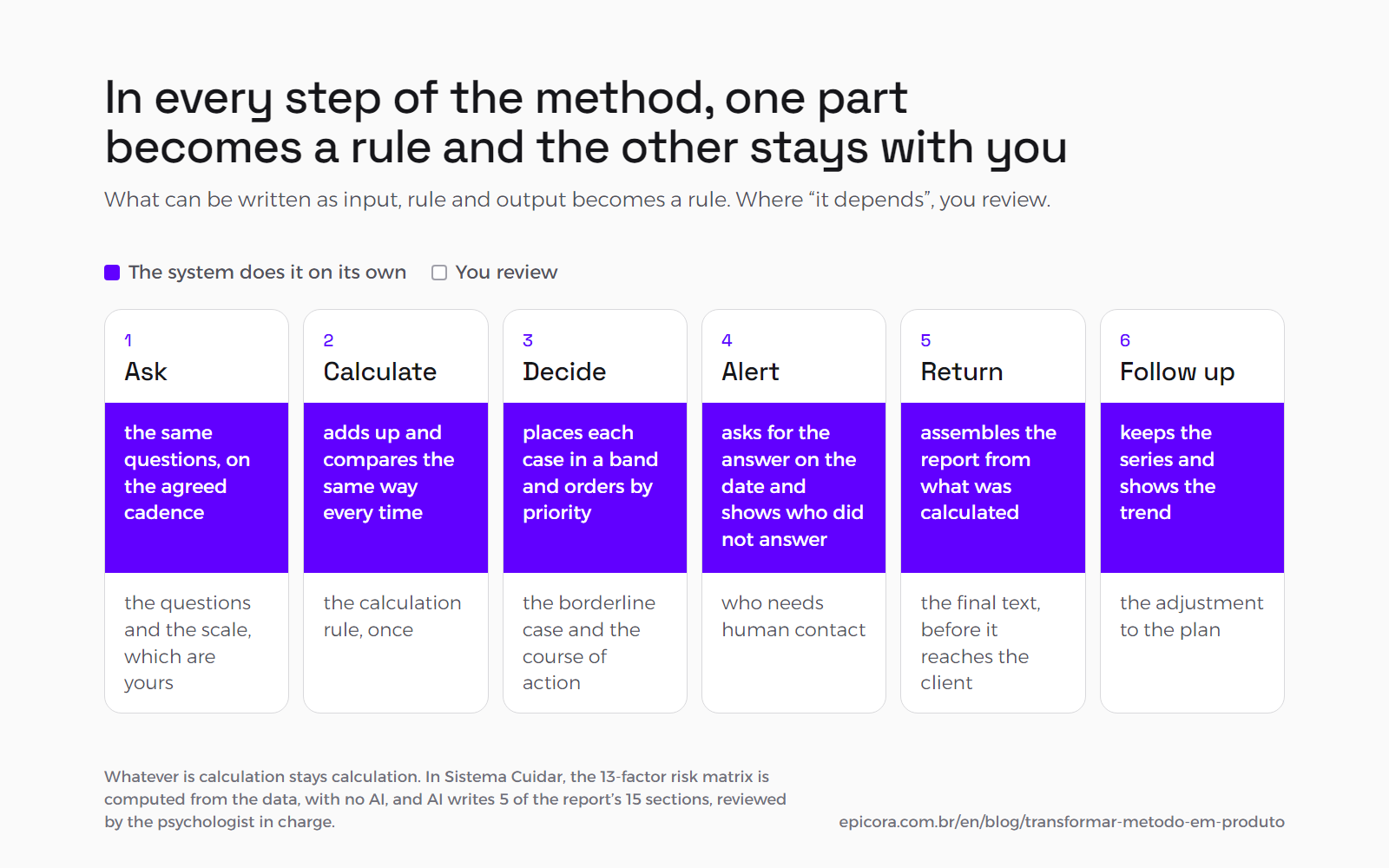
| Step of the method | What the system does on its own | What the professional reviews | Example |
|---|---|---|---|
| Ask | presents the same questions, on the agreed cadence, to the right person | the questions and the scale, which are theirs | the Casa Follow Up protocols, daily or weekly, with the morning and evening pair in the insomnia one |
| Calculate | adds up, compares and records the same way every time | the calculation rule, once, and not each result | the personal record detected set by set at Team Garin |
| Decide | places each case in a band and orders by priority | the borderline case and the course of action | the classification of Cuidar's 13 factors, from Low to Critical, computed with no AI |
| Alert | asks for the answer on the date and shows who did not answer | who needs human contact | Team Garin's recurring questionnaire, weekly, biweekly or monthly, reviewed by the team |
| Return | assembles the result or the report from what was calculated | the final text, before it reaches the client | the 5 sections of the Cuidar report written by AI and reviewed by the psychologist in charge |
| Follow up | keeps the series and shows the trend | the adjustment to the plan | the sleep-score curve with the period average, at Casa Follow Up |
The table has a built-in rule: whatever is calculation stays calculation. In Cuidar, AI only writes the sections that require interpretation, and it is forbidden to invent numerical data or cite authors outside the reference material.
Part of the work is deciding rules that look like details. At Team Garin, the value of each gamification point is set by the coaching business, and stopping training resets the day streak but takes no points away. With many students, the rule has to be written down.
What stays with the professional when the method becomes software#
Three things stay with you: judgment on each case, the method's content and the relationship with the people you serve. The system applies the rule you wrote and does not replace your signature.
Judgment. In Sistema Cuidar, no number in the report came from a language model, and the psychologist in charge reviews the AI-written sections in an editor before export. At Casa Follow Up, AI reads the series but calculates nothing, never mentions medication, dosage or course of action to the patient and, when data is missing, says so instead of filling the gap. Every analysis carries a notice that it does not replace the clinician's assessment.
Content. The 18 Casa Follow Up protocols were written by its clinical team. What we built was the mechanism that carries them: cadence, answer types, themes that cut across protocols. How to protect that, from the contract to the accounts, is covered in how to protect your app idea.
The relationship. At Team Garin, the app gives the student a reason to come back, with community and gamification, but the plan still comes from the team, which also moderates the community and reviews the questionnaires. At Casa Follow Up, patients only join the app by invitation from their clinician.
How your method makes money: subscription, license or one-off sale#
There are four common ways for a method to become revenue: a subscription paid by the person being served, a license for another professional to use the platform, a one-off sale and a product that makes your own service go further. The choice depends on how often the person uses it and on who pays for the result.
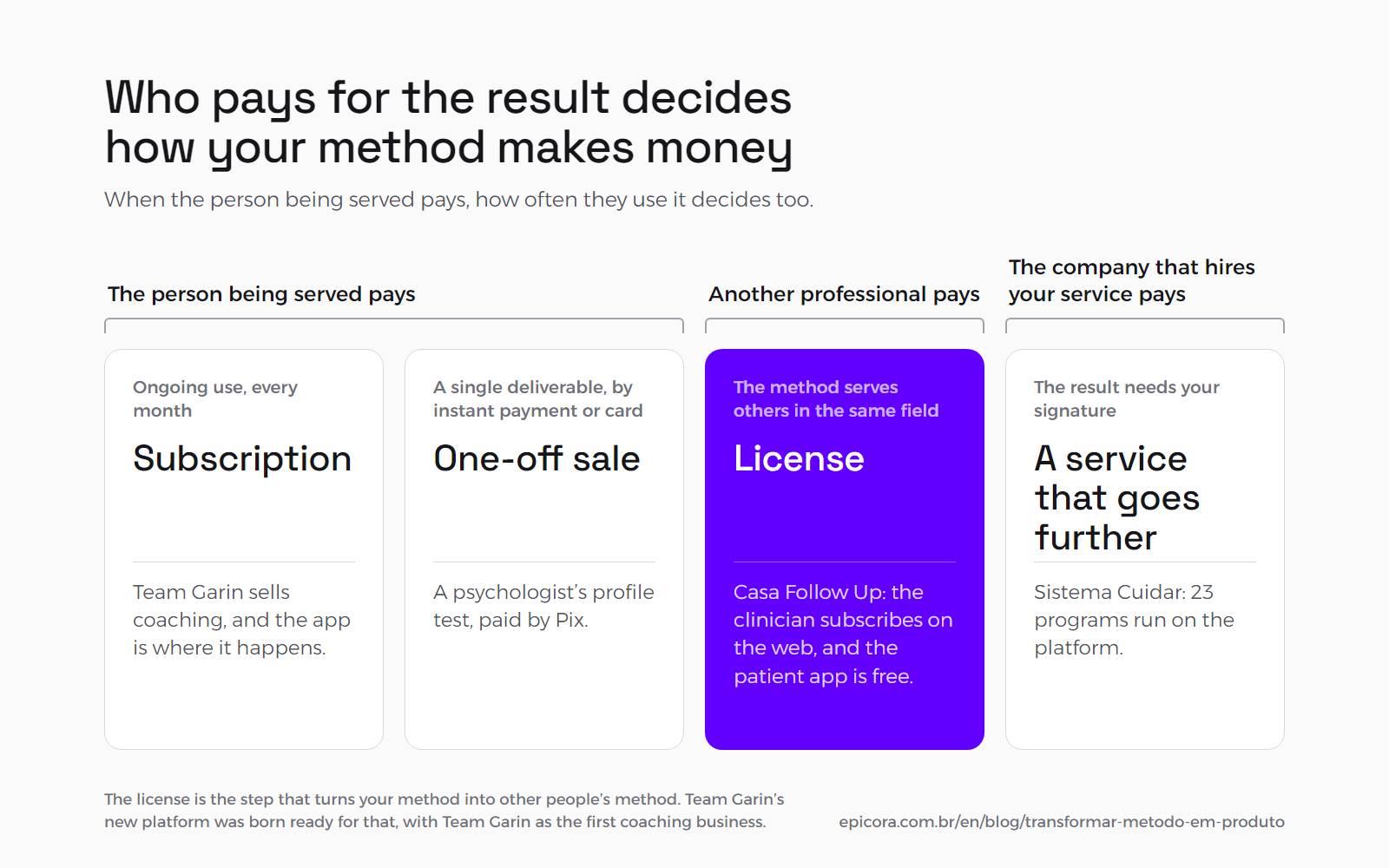
| Model | Who pays | When it fits | Example |
|---|---|---|---|
| Subscription from the person served | the student, the patient or the end client, every month | ongoing use, with follow-up | Team Garin sells coaching, and the app is where it happens |
| License for another professional | the professional or the company that uses the platform | the method serves others in the same field | at Casa Follow Up, the clinician subscribes on the web, and the patient app is free |
| One-off sale | the buyer, once, by instant payment or card | a single deliverable: a test, an assessment, a course | a psychologist's profile test, paid by Pix |
| A service that goes further | the company that hires your service | the result needs your signature | Cuidar, with 23 programs run on the platform |
The license is the step that turns your method into other people's method. Team Garin's new platform was born ready for that, with Team Garin as the first coaching business on it.
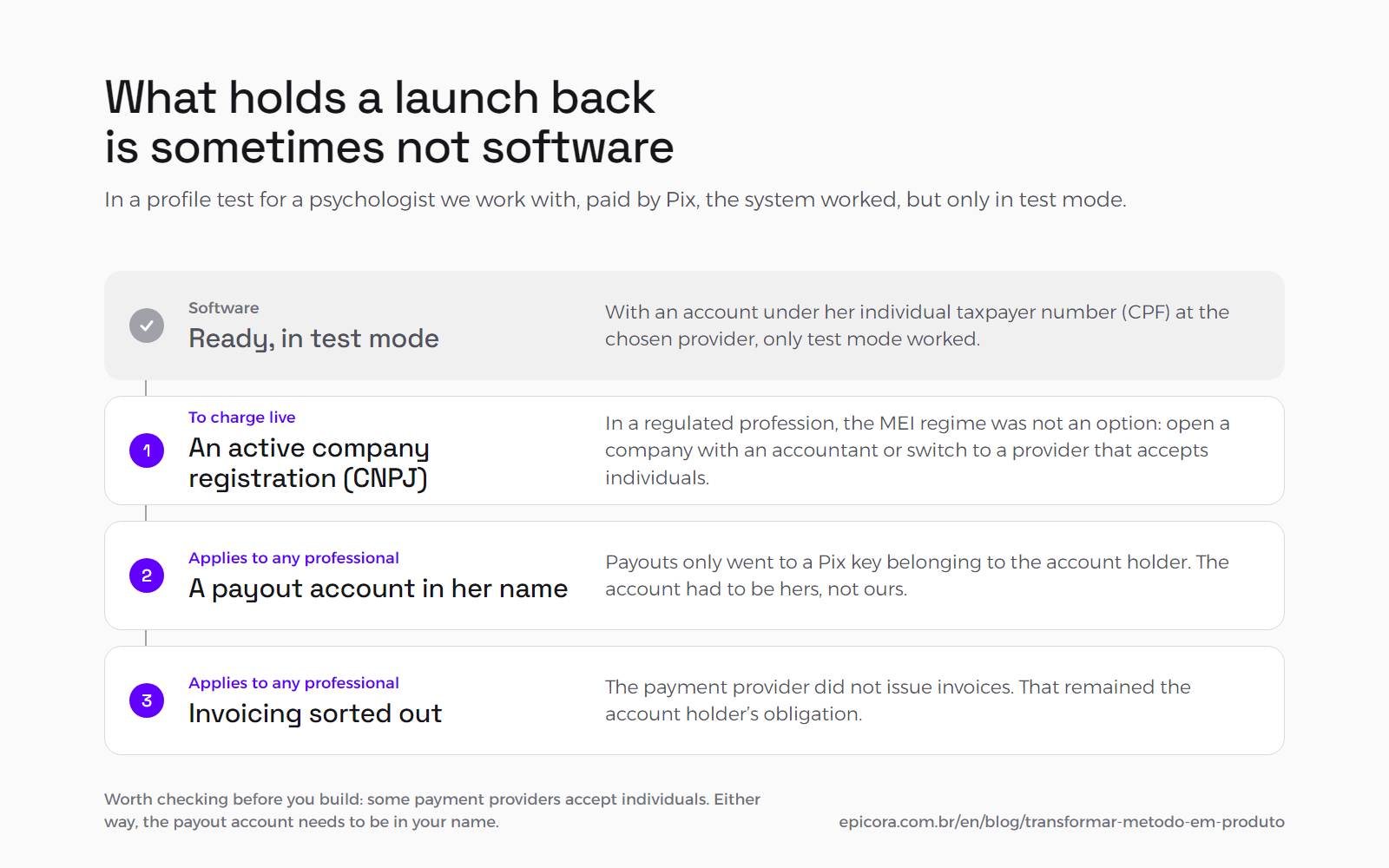
What holds a launch back is sometimes not software. In a profile test for a psychologist we work with, paid by Pix, Brazil's instant payment system, live payments depended on an active company registration (CNPJ) with the chosen payment provider, and an account under her individual taxpayer number (CPF) only ran in test mode. Because hers is a regulated profession, Brazil's micro-entrepreneur regime (MEI) was not an option for her: the way out was to open a company with an accountant or switch to a payment provider that accepts individuals.
Two other things apply to any professional. Payouts could only go to a Pix key belonging to the account holder, so the account had to be hers, not ours. And the payment provider did not issue invoices, which remained the account holder's obligation.
What to do before coding your method#
Before coding, write the method down in steps, decide what stays out of the first version and look at the screens designed. At Epicora, this stage is done together with the professional and at no cost: the method becomes a designed system, with a written scope and a screen prototype, and only then does the project go into development.
- Write each step as input, rule and output. What I ask, what I do with the answer, what I deliver. Wherever you write "it depends", mark it: that is where you review.
- Name who uses it and what each person sees. At Casa Follow Up there are three people and three environments, and the clinician's technical report never appears to the patient.
- Decide the rules that look like details. In the profile test for a psychologist we work with, taking the test is single-use, and the result stays available forever. Whoever receives someone else's link sees that person's result, but does not get a test.
- Cut whatever is not on the buyer's path. In the same project, her admin panel was taken out of scope to lower development cost without touching the buyer's flow. The filter was three questions: if the data already exists in the payment provider, she looks there; if it changes once a year, it is our configuration; if the buyer can solve it alone, it is self-service.
- Look at the screens before paying for development. The prototype is where the missing question and the extra screen show up. Once validated, it becomes the specification for whoever builds it.
- Sort out in parallel what is not software. Company registration, a payout account in your name, invoicing and the review of the texts that carry your signature.
Frequently asked questions#
Can you turn a methodology into software?#
Yes, when the method has steps that repeat the same way for every client: a question, a calculation, a classification, an alert. Those steps become rules the system applies on its own, and whatever requires judgment stays with the professional. In Sistema Cuidar, the 13-factor risk matrix is computed from the data, AI writes 5 of the report's 15 sections and the psychologist in charge reviews them before export.
How do I protect my method if it becomes an app?#
Through the contract and the accounts, more than through the law. Brazil's Copyright Law (Law No. 9,610/1998) states in article 8 that ideas, systems and methods, as such, are not protected by copyright. So ask for a confidentiality agreement before detailing the method, a contract that says who owns the code, and the product's accounts in your company's name from day one.
Do I need a registered company to sell an app?#
It depends on the payment provider, and it is worth checking before you build. In a profile test for a psychologist we work with, live payments depended on an active company registration with the chosen payment provider, and an account under her individual taxpayer number only ran in test mode. Some payment providers accept individuals. Either way, the payout account needs to be in your name, and invoicing needs to be sorted out, because not every payment provider issues invoices.
Is it better to have my own app or a ready-made platform with my brand?#
To start and validate, a ready-made platform with your brand on it, known as white label, usually wins, because it gets you going fast. Your own app starts to pay off when the method becomes the differentiator and the platform will not let you apply your rule, when the data and the client base need to be yours, or when the per-student fee grows faster than the product.
How long does it take for my method to become an app?#
The timeline comes out of the design, not the other way around. First the method is written down in steps and becomes a scope and a screen prototype, which you validate. Then comes the hour estimate for what was designed, and then development, in deliveries you check along the way. If the product goes to the app stores, there is also Apple's and Google's review.
Sources#
- Brazil, Law No. 9,610/1998 (Copyright Law), article 8, on ideas, systems and methods falling outside copyright protection (accessed October 27, 2026): https://www.planalto.gov.br/ccivil_03/leis/l9610.htm
Next step#
Write your method down in steps, with what goes in, the rule and what comes out, and mark where you would write "it depends". That draft is the starting point of the work we do in digital products and SaaS, as with Team Garin, where the coaching team's prescribed workouts became an app. The design, with scope and screen prototype, is done with you and at no cost.
Want to look at this in your case?
Tell us in a few lines what you have today. We reply with the path that makes sense, even when the answer is not to build anything.