
If you have an app idea and can't code, you have four paths, and each one fits a stage: build it yourself with an AI app builder, hire a freelancer, find a co-founder who codes, or hire a software development company. The expensive mistake is skipping the step before: writing down who uses it, what the product does, what stays out and how it makes money, and seeing the screens designed before paying for development. Forja, built by its founders by talking to an AI, already had 1,312 active users when we came in, and it needed engineering because it was already charging customers and storing personal data.
Where to start when you have the idea and can't code#
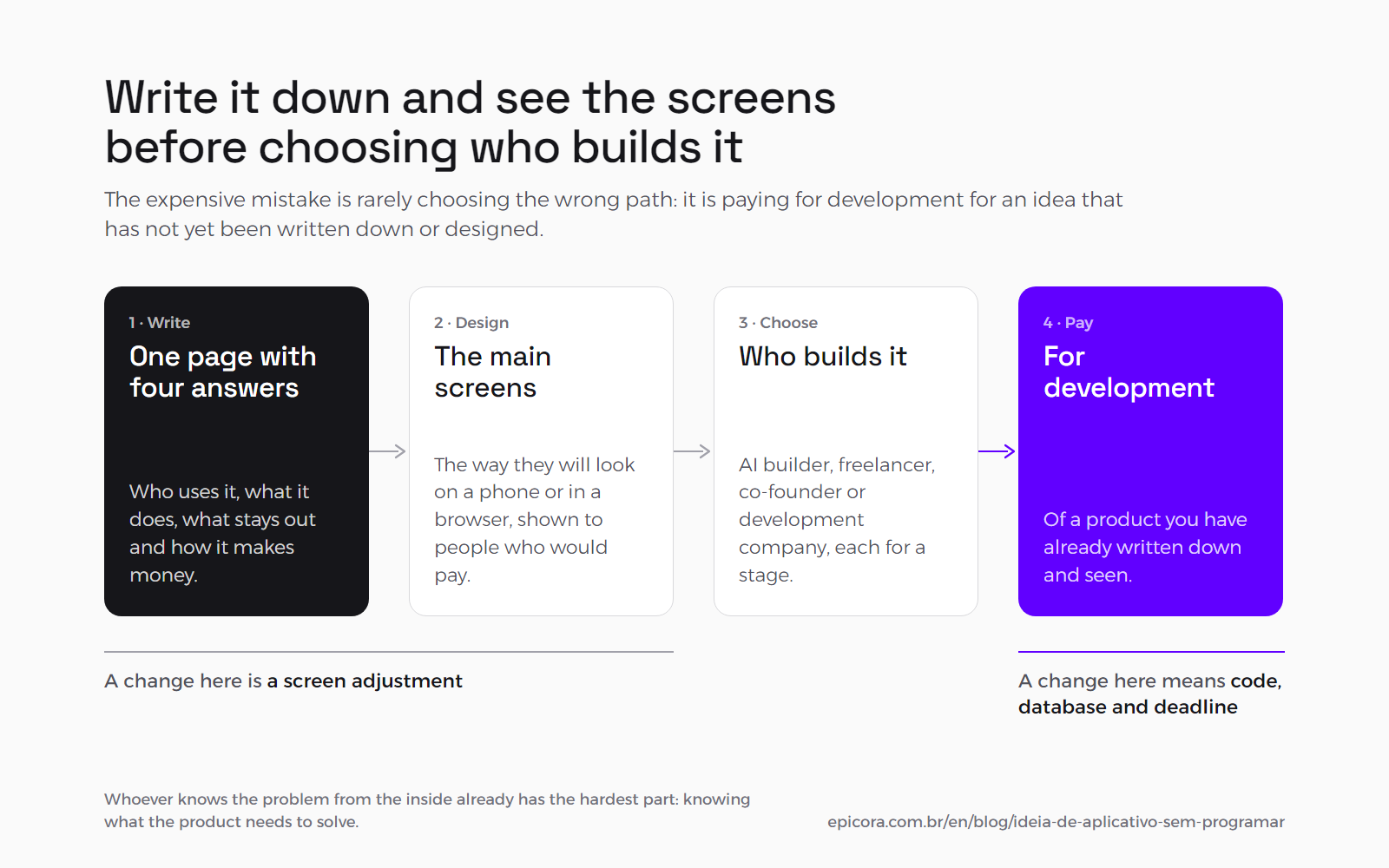
Start by writing down what the product does and for whom, and by seeing the screens designed, before you choose who will build it. You do not need to know how to code, and you do not need to start by hiring someone to build the whole system. Once that is done, there are four paths, and each one fits a stage.
- Build it yourself with an AI app builder, such as Lovable, Base44 or Bolt: you describe what you want in a conversation and the tool puts the app together. It works for testing the idea quickly.
- Hire a freelancer: a developer builds one piece and charges by the hour or by the delivery. It works when the piece is well defined.
- Find a co-founder who codes: they build in exchange for a share of the company. It works when technology is what sets the business apart.
- Hire a software development company: a company builds the product from a scope and validated screens. It works when the product will charge customers, store other people's data or be in the app stores.
The person asking usually knows a problem from the inside, like a doctor, a lawyer, a personal trainer or a consultant, and already has the hardest part: knowing what the product needs to solve. The expensive mistake is rarely choosing the wrong path: it is paying for development for an idea that has not yet been written down or designed. Taking the idea all the way to software someone pays to use is the work of digital products and SaaS.
What to write down before talking to anyone#
Write one page with four answers: who uses it, what the product does, what stays out and how it makes money. That page is what lets you ask for a quote, test the idea in an AI builder or explain it to a co-founder, and almost nobody arrives with it ready.
- Who uses it. Each type of person who logs into the app and what each one can see and do. In a training coaching business, the client logs the set and the team reviews the plan: two screens for the same data.
- What it does, in a single path. The main journey from start to finish, in three or four steps. If the product does not fit in that journey, it is still a wish list.
- What stays out. Written as clearly as what stays in. At Helpe, a local-services marketplace we built, the decision was not to handle payments: the button on the profile opens WhatsApp straight to the professional. That one line left out the whole machinery of held payments, split payouts and disputes.
- How it makes money. Who pays, why and how often. At Helpe, the professional subscribes to get a public storefront and the client searches for free across 33 service categories. That asymmetry defined the whole product.
Once the page is written, show it to people. An idea is not protected by hiding it: if you show your idea to no one, you also never find out whether it sells. What the law and a contract actually protect is a separate topic, how to protect your app idea.
AI builder, freelancer, co-founder or development company: when each path fits#
Each path trades money for a different risk. The AI builder is the cheapest way to start and the riskiest once the app charges customers or stores data; the freelancer depends on you being able to say what you want; the co-founder costs a share of the company; the software development company costs more and requires the scope to come first.
| Path | When it fits | What it costs to start | Main risk | What you need in hand |
|---|---|---|---|---|
| AI app builder (Lovable, Base44, Bolt) | testing the idea and showing the first version to the people who will use it | the builder's monthly subscription and the cloud the app runs on | security flaws nobody reviewed and a cloud bill growing without anyone noticing | the written page and time to talk to the tool |
| Freelancer | building one well-defined piece: a screen, an integration, an adjustment | freelancer hours | a product with no technical owner once they leave, and accounts in their name | the written scope of the piece and the accounts in your name |
| Co-founder who codes | when technology is what sets the business apart | a share of the company, instead of money | they share the business for good, and disagreement between partners stalls the product | a written partnership agreement, with who decides what |
| Software development company | a product that will charge customers, store other people's data or be in the app stores | at Epicora, scope and prototype at no cost; then the project estimated in hours | paying for development before seeing the screens, and accounts in the vendor's name | the written page and time to validate the screens |
The paths are not mutually exclusive: you can start in the builder and bring in a software development company when the first customer is about to pay. The same rule holds on every path: code, cloud, database, domain and app store account in your company's name from day one.
How far an app you build yourself with an AI builder can go#
All the way to market. An AI app builder can stand up a product that sells, and what it does not solve on its own is who can call what, who pays for the infrastructure and what happens the day something goes wrong. The builder is not the villain, and it is not the end of the road either.
Sistema Forja, a gamified personal development platform, was built by its own founders talking to an AI, with no engineering team. When we came in, in February 2026, it had 1,312 active users and was already selling subscriptions.
The audit found nine security flaws, two of them critical. The eight server functions accepted calls from anyone, without authentication, including the payment ones, and any user's habits, goals and sleep and mood logs were visible to everyone else. The infrastructure, on the managed cloud built into the AI tool itself, cost about R$2,000 a month.
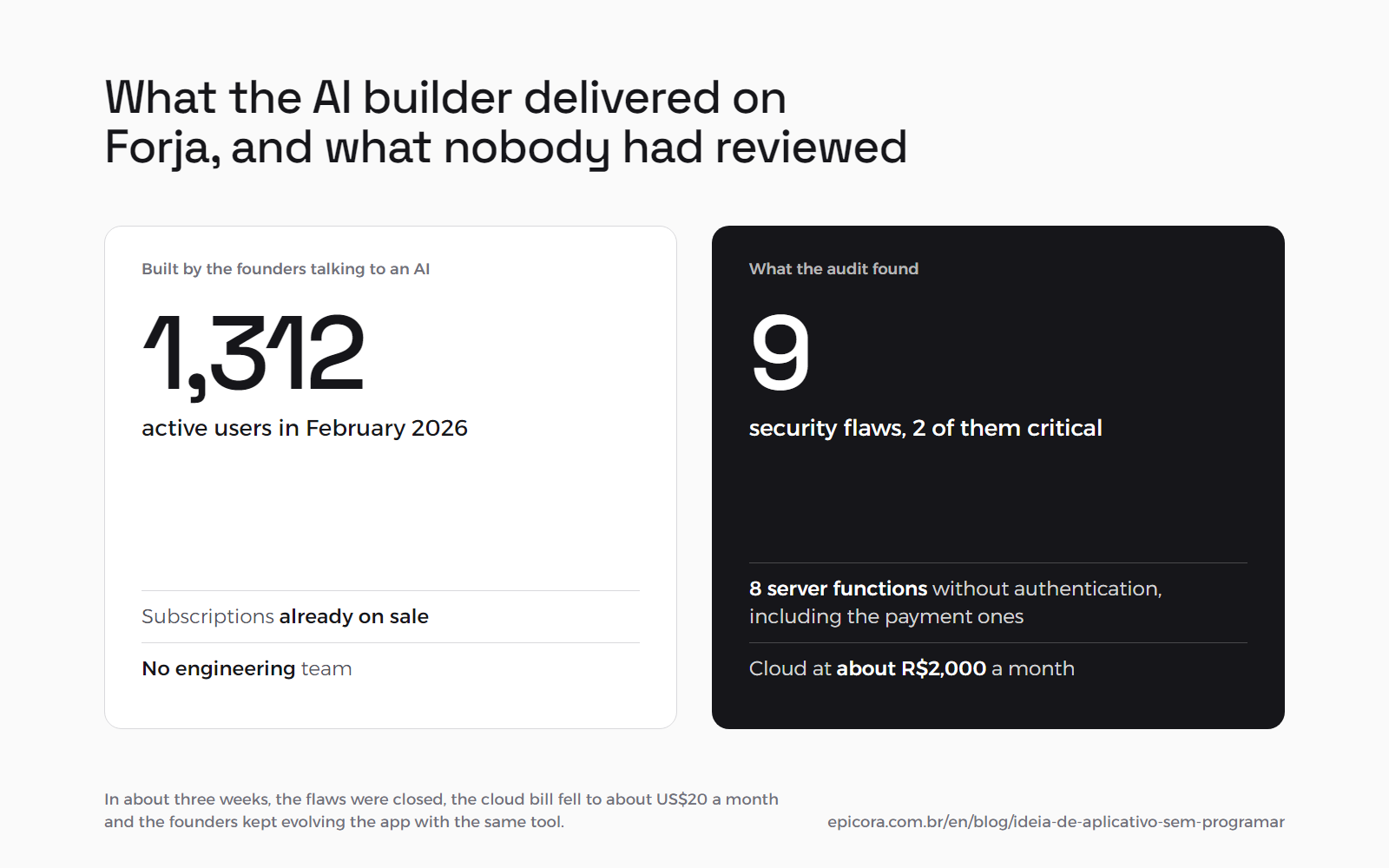
In about three weeks, from the audit to the last fix, we closed the flaws, brought the bill down to about US$20 a month and handed back 100% of the product running on the client's own accounts. What had been built with AI stayed live, and the founders kept evolving the app with the same tool.
The builder served the stage that matters most, reaching the market and finding out that the idea sells, and it started to call for engineering once the app was already charging customers and storing personal data. If you start there, leave real payments and personal data until after a review of who can call each function and read each record, and look at the cloud bill every month.
The signs that it is time to take the app out of the tool are in when an app built on Lovable needs to leave Lovable, and what can be kept is in what you can salvage from AI-generated code. Once the app is live, the first step is an audit of what the AI built, not a new system.
Why you should see the screens designed before paying for any development#
Because the screen is where the idea becomes something you can judge, and a change costs little in a design and a lot in a built system. At Epicora, this step is done together with the person who has the idea, at no cost: we write the scope and design the screens, and only then does the project move on to development.
The scope says who uses the product, what each profile does, which rules the system applies on its own and what stays out. The prototype is the main screens in high fidelity, the way they will look on a phone or in a browser. You validate the screens, the scope is revised with what the validation showed, and the hours estimate and the proposal come afterwards, for a product both sides have already seen.
A list of features looks complete until the person who will use the product sees the screen and asks where the thing they do today in a notebook, a spreadsheet or on WhatsApp has gone. Answered in the design, that question becomes a screen adjustment. Answered after the code is written, it becomes a change to the code, the database and the deadline.
The screens also test the idea with the people who would pay for it before a single line of code exists. What goes into the first version is in how to validate the idea before you invest.
When it makes sense to hire someone to build the app#
When the product will charge customers, store other people's data or need to be on the App Store and Google Play. In those three cases, a mistake stops being an ugly screen and becomes money, personal data or a rejected app, and that is where reviewed engineering pays for itself.
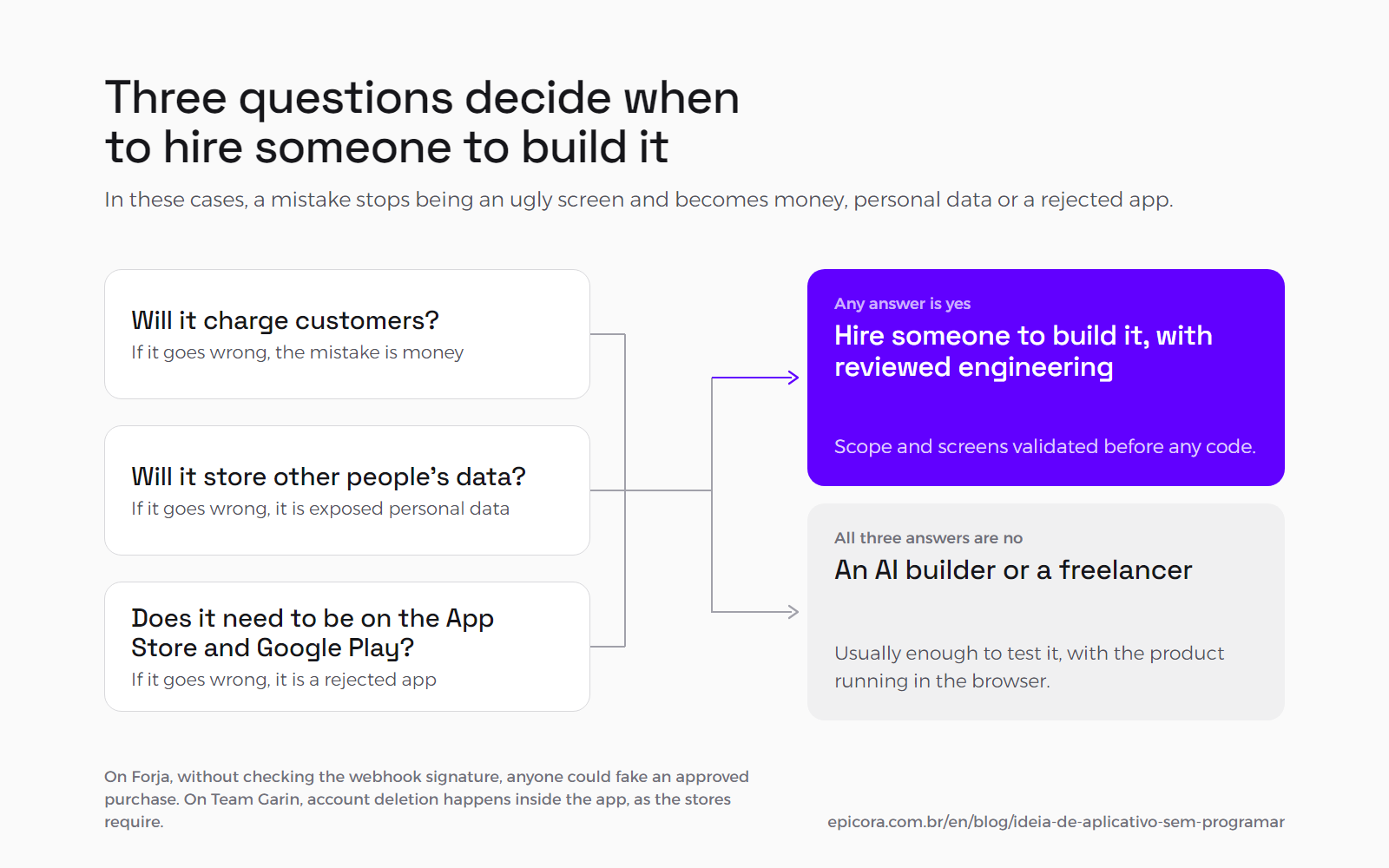
- It will charge customers. On Forja, the AI-built app we audited, without checking the signature on the payment notice that reaches the server (the webhook), anyone who found the address could fake an approved purchase and unlock a lifetime subscription.
- It will store other people's data. On Team Garin, the training coaching business whose app we built, assessment photos and documents sit in private storage and only open through a signed link with an expiry, 5 minutes for a questionnaire photo.
- It needs to be in the app stores. In the Team Garin app, account deletion happens inside the app, as the stores require, and a client can block another client, as the App Store requires of apps with user content.
Team Garin, an online training and nutrition coaching business, took the software development company path from start to finish. We built the platform since its first version, and as of September 2, 2026 it had 416,000 logged sets. The new generation was designed on top of the usage measured in the database, and since October the whole client base runs on the new app, published on the App Store and Google Play.
And the reverse holds too. If the product does not charge anyone yet, stores no one's data and runs in the browser, an AI builder or a freelancer is usually enough to test it. What to ask for and check when it is time to hire is in how to hire a software development company.
Frequently asked questions#
Can you build an app without knowing how to code?#
Yes. An AI app builder, such as Lovable, Base44 or Bolt, puts an app together from a conversation, and you can reach the market that way: Forja was built by its own founders talking to an AI and already had 1,312 active users when we came in. What the builder does not solve on its own is security, the cost of the infrastructure and what happens when something goes wrong.
Do I need a technical co-founder to get the idea off the ground?#
Not necessarily. A technical co-founder is a partnership decision: they share the business with you for good, and it makes sense when technology is what sets the product apart. If what sets it apart is your method, your market or your operation, hiring someone to build it is usually faster, as long as the scope and the screens come first.
How much does it cost to start an app?#
It depends on what the app does, so be wary of a price given before anyone understands the idea. What moves the bill the most is how many types of user the app has, whether it takes payments, how many systems it talks to and whether it needs to be in the app stores. At Epicora, the scope and the screen prototype are done with you at no cost, and the hours estimate comes afterwards. Once the app is live, there is the cost of running it: on Forja, an AI-built app we audited, the infrastructure went from about R$2,000 to about US$20 a month.
Is it worth starting on Lovable or another AI app builder?#
Yes, for testing the idea and showing the first version to the people who will use it. The builder stops being enough when the app starts charging customers, storing other people's data or needing the app stores. At that point, the shortest path is usually an audit of what was built, not a rewrite: on Forja, an AI-built app that was already selling, the client kept evolving the app with the same tool after the fixes.
How do I know whether my app idea is worth it before I invest?#
By showing the idea to people who would pay for it, before writing any code. Write down who uses it, what the product does, what stays out and how it makes money, design the main screens and take that to the people who would be your customers. Hearing that someone liked it is not validation. A payment, a pre-sale or repeated use is.
Next step#
Before choosing a path, write the page with the four answers and ask to see the screens. If the idea is a product to sell, that is the work we do in digital products and SaaS, starting with the scope and the screens, at no cost. If the app already exists and was built with AI, the starting point is an audit, as in the Forja case.
Want to look at this in your case?
Tell us in a few lines what you have today. We reply with the path that makes sense, even when the answer is not to build anything.